The Death of a Companion Animal

The Death of a Companion Animal

I write this brief article as we prepare once again for the day when we give permission for the veterinarian to end the life of a beloved pet.  This will signify almost the end of a 13 year long journey which started in Cyprus when Katie, a six week old puppy, was abandoned outside our home in Pervolia. We already had two rescue dogs from our time in Chile and whilst my first inclination was to ask the Nicosia Dog shelter to take her, when we learnt they had an outbreak of Parvo-virus, we decided to keep her. This will be the third time in three years that we have endured this experience, for our two rescues from Chile in 2002 – Humboldt and Ingrid, died in 2015 and 2016 respectively. I say almost the end because once her life has ended, there begins the final phase – that of mourning her death.  It is the recognition of the need to mourn for a companion animal that results in this article.

Last year I discussed with a Greek friend and psychologist, the pain I suffered when one of our pets died . She surprised me when stating that the inability to mourn and grieve for a companion animal was one reason for depression in a significant number of her patients. In her experience, the repression of grief was worst among those who identified as Christians. This repression arose soon after individuals expressed their grief, only to be dismissed with comments such as ‘it’s just a dog’ or cat, which was viewed as a belittling of the individual and a dismissal of their animal’s life as insignificant and irrelevant.  For some, the grief is internalised and gives rise to depression.  There would seem to be both an opportunity for academic research in this area but also the need to raise the subject for discussion.

In my research I have both early and contemporary Orthodox commentary from senior theologians on a number of issues and whilst this subject has not as yet been discussed, certain comments from Patristic sources may guide us.  For example, St. Irenaeus informs us that ‘among the “all things” our world must be embraced’[1]; St. Athanasius, states that ‘nothing in Creation had gone astray in its notions of God, save the human being only’[2], whilst the Psalms, the poetry of St Ephrem and St. Gregory Nazianzen and our liturgical texts inform us of a type of ‘knowing’ where all creatures recognise and worship God. [3] In contemporary commentary we are taught that everything that lives is ‘Holy and therefore, the way we treat animals is directly relevant to our living of the Christian Life’[4]; that animals should be treated with ‘reverence and respect[5] and that whilst humans are at the top of a hierarchical scale, ‘this is not to denigrate the rest of creation.  They are God’s Creation and we must respect that and treat them respectfully’.[6] Bishop Isaias teaches that

  • If you are a good Christian you will love the animals and they will love you back and there are many books showing this through the lives of the early Saints as I said before. You cannot find a Holy man who has mistreated animals.[7]

It would seem entirely Orthodox therefore to grieve for the loss of a companion animal who, for example, may have been a long-term member of the family; the only close companion of the owner; or who may have been the last link with the earlier death of a partner or child. Regardless of the reason, for many there appears to be a genuine need to grieve. There is also the need for us to show compassion to our human friend, relative or member of our congregation in this situation.

Teachings which indicate that we are to treat animals with respect when they are alive would seem to lead us to the conclusion that we are also to be mindful of them when they die.  This mindfulness may take many forms. Some owners may feel that once their animal is dead, that they can be disposed of by their vet or any other method, whilst others may wish to bury their animals in their garden. Some might also like a prayer of thanksgiving in remembrance of their animal’s love, friendship and loyalty.  Some non-Orthodox theologians have provided prayers for this ceremony[8] yet whilst Orthodoxy offers prayers for sick animals[9] there does not appear to be prayers to bring comfort to owners at the death of their companion animals. It was for this reason that Fr. Simon combined prayers from the Orthodox prayer book with an element from the Linzey text[10] in order to provide the theological context of praising God for the life of their animal. Let us know your thoughts.

Prayer at the death of companion animals

Holy God, Holy Mighty, Holy Immortal, have mercy on us. (3)                                                            Glory to the Father and to the Son and to the Holy Spirit, now and ever, and to the ages of ages.  Amen.

O God of all spirits and of every flesh, everything that has breath praises you both in this world and the next.  Heaven is full of the sounds of creaturely voices in a great cacophony of praise and thanksgiving.  Day and night your creatures praise you, without ceasing and with joy.

In your all-encompassing mercy, O God, we now commit the life of this our beloved friend and companion (name) to eternal fellowship with you.Create within us a spirit of gratitude for the life of (name) Give rest, O God, to (name) who lived among us and gave us freely of (his/her) love.

 Holy Father, your Son Jesus Christ taught us that not one sparrow is forgotten in your sight. We ask therefore for you to provide a place of green pasture where (his/her) praises will be heard in your presence and where (he/she) shall be free from suffering and pain.

God our Creator, hear our prayer and let our praise unite with those in heaven into one long song of eternal thanksgiving:

Glory to You, O Christ our God, the source and destiny of all living things.                                      Glory to You, O Christ our God, Who bears the wounds of all suffering creatures.                            Glory to You, O Christ our God, Who transforms all suffering into joy.

St. John saw the new heaven and earth; a place without pain, sorrow or crying;                            for the same God who creates, is the same God who reconciles and                                    redeems all creation.

            Glory to You, O Christ our God and Saviour of the Universe:                                                                              in Christ shall all be made alive.

Holy God, Holy Mighty, Holy Immortal, have mercy on us. (3)                                                                   Glory to the Father and to the Son and to the Holy Spirit, now and ever, and to the ages of ages.

Amen.

Editor’s note

This morning, permission was given to end the life of our beloved dog Katie. May she rest in peace.

References:

[1] Irenaeus, Against Heresies 2:2:5.

[2] Athanasius, On the Incarnation of the Word 43:3.

[3] E.g., Ephrem the Syrian, Nineteen Hymns on the Nativity of Christ in the Flesh, 13:27 CANNPNF2-13;  Hymn to the God  St. Gregory Nazianzen: Selected Poems (4th Ed.) McGuckin, J. (Trans.) Oxford: SLG Press.(2005)

[4] Ware, Met. K. Oxford interview 2014.

[5] Ibid.

[6] Isaias, Bishop.  Interview, Tamasou & Orinis, Cyprus. (2014)

[7] Ibid.

[8] Linzey, Prof. Rev. A. Animal Rites: Liturgies of Animal Care, London: SCM Press.(1999) 

[9] Prayer of St. Modestos,  Mikron Euchologion i Hagiasmatarion, p. (1984:297)

[10] With Prof. Linzey’s permission.

Met. Kallistos of Diokleia – Brief Biography & Bibliography

The Most Reverend Kallistos (Ware), Metropolitan of Diokleia (Born Timothy Ware in Bath, Somerset, England at 1934) is an auxiliary bishop of the Ecumenical Patriarchate in Great Britain.

Metropolitan Kallistos was educated at Westminster School (to which he had won a scholarship) and Magdalen College, Oxford, where he took a Double First in Classics as well as reading Theology.

In 1958, at the age of 24, he embraced the Orthodox Christian faith (having been raised Anglican), traveling subsequently throughout Greece, spending a great deal of time at the Monastery of St. John the Theologian in Patmos.

He also frequented other major centres of Orthodoxy such as Jerusalem and Mount Athos. In 1966, he was ordained to the priesthood and was tonsured as a monk, receiving the name Kallistos.

In the same year, he became a lecturer at Oxford, teaching Eastern Orthodox Studies, a position which he held for 35 years until his retirement. In 1970, he was appointed to a Fellowship at Pembroke College, Oxford, and in 1982, he was consecrated to the episcopacy as an auxiliary bishop with the title Bishop of Diokleia, appointed to serve as the assistant to the bishop of the Ecumenical Patriarchate’s Orthodox Archdiocese of Thyateira and Great Britain. Despite his elevation, Bp Kallistos remained in Oxford and carried on his duties both as the parish priest of the Oxford Greek Orthodox community and as a lecturer at the University.

Since his retirement in 2001, Met. Kallistos has continued to publish and to give lectures on Orthodox Christianity, travelling widely. Until recently, he was the chairman of the board of directors of the Institute for Orthodox Christian Studies in Cambridge. He is the chairman of the group Friends of Orthodoxy on Iona. He is the Chairman of the Anglican-Orthodox Theological Dialogue. On 31st March 2007 he was elevated to Metropolitan.

Met. Kallistos is perhaps best known as the author of the book The Orthodox Church, published when he was a layman in 1963 and subsequently revised several times. More recently, he produced a companion volume, The Orthodox Way. But his most substantial publications have emerged from his translation work. Together with G. E. Palmer and Philip Sherrard), he has undertaken to translate the Philokalia (four volumes of five published to date); and with Mother Mary he produced the Lenten Triodion and Festal Menaion.

Writings

A partial bibliography:

  • Ware, K. (1971a) ‘The Value of the Material Creation’ Sobernost 6 (3): 154-165.
  • (1971b) ‘The Mystery of God and Man in St. Symeon the New Theologian’ Sobornost, 6.4 (1971):227-36.
  • (1973) ‘Scholasticism and Orthodoxy: Theological Method as a Factor in the Schism.’ Eastern Churches Review 5.1 (1973): 16-27.
  • (1977) ‘Separated from All and United to All: The Hermit Life in the Christian East’ in, Allchin, A. M. (Ed.) Solitude and Communion. Oxford: Fairacres Publications, pp. 30-47.
  • (1983) ‘Wolves and Monks: Life on the Holy Mountain Today.’ Sobornost 5.2 (1983): 56-68.
  • (1986) ‘The Human Person as an Icon of the Trinity’ Sobornost 8.2 (1986): 6-23.
  • (1987) ‘Spirit, Church, Eucharist’ The Franciscan, 29.2 (1987): 77-84.
  • (1991a) ‘The Spirituality of the Philokalia’ Sobornost 13.1 (1991): 6-24.
  • (1991b) ‘Tradition, the Bible and the Holy Spirit’ Epiphany, II.2 (1991): 7-16.
  • [1992](1995a) (Rev. Ed.) The Orthodox Way Crestwood, NY: SVSP.
  • (1995b) ‘The Way of the Ascetics: Negative of Affirmative?’ in, Wimbush, V. L. & Valantasis, R. (Eds) Asceticism Oxford: OUP, pp. 3-15.
  • (1996a)  How Are We Saved? The Understanding of Salvation in the Orthodox Tradition Minneapolis, MN: Light and Life.
  • (1996b) ‘In the Image and Likeness: The Uniqueness of the Human Person’ in, Chirban, J. T. (Ed.) Personhood: Orthodox Christianity and the Connection Between Body, Mind, and Soul Westport, CN: Bergin & Garvey, pp. 1-13.
  • (1996c) ‘Lent and the Consumer Society’ in, Walker, A. & Carras, C. (Eds) Living Orthodoxy in the Modern World London: SPCK. pp. 64-84.
  • (1997a) [1993] The Orthodox Church. London: Penguin.
  • (1997b) Through the Creation to the Creator Ecotheology 2. (1997):8-30.
  • (1997c) ‘We Must Pray for All: Salvation according to St. Silouan’ Sobornost 19.1 (1997): 34-51.
  • (1997d) ‘My Helper and My Enemy: The Body in Greek Christianity’ in, Coakley, S. (Ed.) Religion and the Body. Cambridge: Cambridge University Press, pp. 90-110.
  • (1999a) ‘The Soul in Greek Christianity’ in, James, M. & Crabbe, C. (Eds) From Soul to Self. London & New York: Routledge, pp. 49-69.
  • (1999b) ‘Kenosis and Christ-Like Humility according to Saint Silouan’ Sobornost 21.2: 21-31.
  • (2000) ‘Go Forth in Peace’ in, Communion (May 2000): I-7.
  • (2001a) The Inner Kingdom: The Collected Works, Vol. 1 Crestwood, NY: SVSP.
  • (2001b) ‘The Light that Lightens Everyone: The Knowledge of God Among Non-Christians according to the Greek Fathers and St. Innocent’ in, Greek Orthodox Theological Review, 44: 557-64.
  • (2001c) ‘It Is Time For The Lord To Act: The Divine Liturgy as Heaven on Earth’ Sobornost 23.1 (2001): 7-22.
  • (2005a) Ecological Crisis, Ecological Hope: The Orthodox Vision of Creation. Orthodoxy in America Lecture, Bronx, NY: Fordham University. [Online] Available at: http://www.fordham.edu/downloads/file/2078/kallistos_lecture.
  • (2006) ‘The Unity of Scripture and Tradition: An Orthodox Approach’ in, McCosker, P. (Ed.) What is it that Scripture Says? Essays in Biblical Interpretation and Reception in Honour of Henry Wansbrough OSB London: T & T Clarke, pp. 231-246.
  • (2008) ‘How To Read The Bible’ in, The Orthodox Study Bible Dallas: Thomas Nelson, pp. 1757-1766.
  • (2011) ‘Sobornost and Eucharistic Ecclesiology: Aleksei Khomiakov and his successors’ International Journal for the Study of the Christian Church, 11(2–3): 216–35.
  •  (2012) ‘Orthodox theology today: trends and tasks’, International Journal for the Study of the Christian Church, 12:2: 105-121.
  • (2014) Compassion for Animals in the Orthodox Church, International Conference on Religion and Animals, St. Stephen’s House, Oxford, UK. 21-23rd July. Contact Prof. A. Linzey, Oxford Centre for Animal Ethics, 91, Iffley Road, Oxford, OX4 1EG,  depdirector@oxfordanimalethics.com. 

He has also co-authored, edited, and translated many other works.

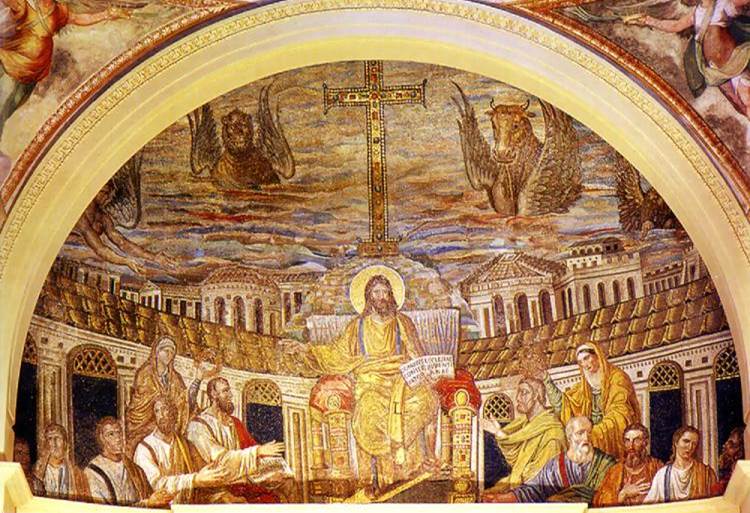
Animals in Orthodox Iconography

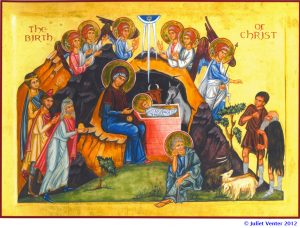
An Icon is being developed for the theme of animal suffering by Aidan Hart.  It will be displayed here once complete.  In the meantime i have added some others and Fr Andreas will give us more information in the not too distant future. The first, is a mosaic and taken from the garden of Kykkos Metochion in Nicosia, Cyprus.  If you have others please send them through to me at panorthodoxconcernforanimals@gmail.com.

Christ overlooking Adam’s naming of the animals.