THE POCA YEARLY REVIEW 2025
POCA consists of a group of well-respected Orthodox theologians, ethicists, academics and laity, whose mission is to promote Christian respect and responsibility for the animal creation through Eastern Orthodox teachings. We began in 2017, are a Registered Charity in the UK and this is our Review of 2025.
JANUARY
We began the year with the good news that both of our books on Climate Crisis and Creation Care were now available in paperback, and thus greatly reduced in price.
https://www.cambridgescholars.com/product/978-1-5275-7421-2
https://www.cambridgescholars.com/product/978-1-5275-7420-5
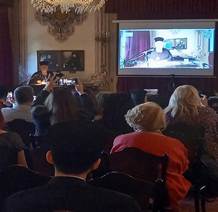
FEBRUARY In February we produced our first Webinar on the work of Met. Kallistos of Diokleia and Animals, using unseen videos produced for our charity. We were blessed to have top theologians from various countries – Archdeacon Fr John Chryssavgis from the USA; Fr Nektariy Sokolov from Russia; Dr Nikolaos Asproulis from Greece and Dr Elizabeth Theokritoff and Dr Christina Nellist from the UK, discussing themes mentioned by Met Kallistos. It was hosted for us by the Volos Academy in Greece, which is one of the organisations we work closely with throughout the year. Here is the link: THE WORK OF MET. KALLISTOS OF DIOKLEIA ON CARE FOR ANIMALS AND THE ENVIRONMENT. WEBINAR 1 – Pan-Orthodox Concern for Animals
MARCH In March we promoted petitions to end cages and crates for all farmed animals, and to ban the culling of badgers, calling for the government to accept the science and adopt other approaches to bovine TB control, and you will see, later in the year this produced some successful results.
We also posted an important interview with one of our Patrons Met. Seraphim on Ecological Repentance and here is the link – WCC interview with POCA Patron Met. Seraphim on ‘Ecological Repentance is the path to Justice’ – Pan-Orthodox Concern for Animals
APRIL In April, we posted the lecture by Ekaterini Tsalampouni, a supporter of our work and Professor of New Testament in the Faculty of Theology of the Aristotle University of Thessaloniki, “‘Cosmic Liturgy’ and the Care for the Creation.” See: https://acadimia.us8.listmanage.com/track/click?u=9eb49964b8f057dadfc67eaea&id=82c8c64b85&e=11fd27f327 or here https://acadimia.us8.list-manage.com/track/click?u=9eb49964b8f057dadfc67eaea&id=0dd25ede1a&e=11fd27f327
We began working in earnest on the forthcoming book on presenting the papers from our session on compassionate care for animals/creation at the International Orthodox Theological Association’s conferences in Volos, Greece. The working title Creation Care: Eastern Orthodox Christian Perspectives. It will be published by Holy Cross and is edited by Dr Christina and Dr Nikolaos. It will be available in the new year.
MAY In May our President was invited to give a workshop to the Orthodox Fellowship of St John the Baptist Youth Group, where she discussed the animal food diet and environmental damage, and asked for information on their views of climate change.

At the end of the month our President was invited to give two lectures on the same day, one in Greece and the other in the UK. The lecture for the Volos Academy, was for their conference on ‘Food in the Anthropocene: Ecotheological and Scientific Perspectives.’ This a topic that has not been discussed yet in any Orthodox context, while it is variously related to the current climate crisis (e.g. agriculture, production models, carbon emissions, lifestyle, poverty). The conference invited participants to consider food cultures, food security, and agricultural systems as gateways to examining the dialectical relationship between ecosystems, cultural beliefs and practices, and religious cosmologies and rituals in sustaining meaningful and equitable ways of living in the Anthropocene. The focus on food allows for the examination of collective human beliefs and practices related to land and natural resource use and patterns of production and consumption in a time of rapid ecosystem collapse, evidenced by ever-increasing wildfires, heat waves, droughts, floods, economic instability, and wars dislocating people from life-sustaining resources and settlements. However, with foresight, the lecture was sent to Dr Asproulis, who read the paper when the Zoom connection was lost just before her presentation! The feedback was that the paper provoked a good discussion on the need for each of the 8.5 billion people on the planet to reflect on their intake and where possible to reduce the consumption of animal and dairy products as a first step in reducing the harmful impact of this diet on water, soil and GHG emissions.
Dr Nellist chose to give her lecture ‘The Animal-Based Diet: Important Considerations’ at the Deanery Conference, part of which also included the need to reduce our consumption of animal-food products, and where the subject provoked an interesting discussion on how people received the same lecture with polar-opposite views!
JUNE
In June we informed our readers of the agreement on Biodiversity Beyond National Jurisdiction (BBNJ), also known as the High Seas Treaty, which aims to safeguard marine life in international waters. During the Ocean conference, nineteen countries ratified the treaty, taking the total to fifty of the sixty countries required for the treaty to enter into force, with others indicating their intent to ratify the treaty in the near future. A notable event was the statement from Angelika Lātūfuipeka Tukuʻaho, the princess of Tonga, who called for the “recognition of whales as legal persons” and that “The time has come to recognise whales not merely as resources, but as sentient beings with inherent rights.” The Pacific island nation could move forward with legislation ensuring this recognition and allowing for “appointing human guardians to represent [whales] in court.” The bill would also seek to ensure whales’ “rights to life, migration, a healthy habitat and cultural protection.”
JULY
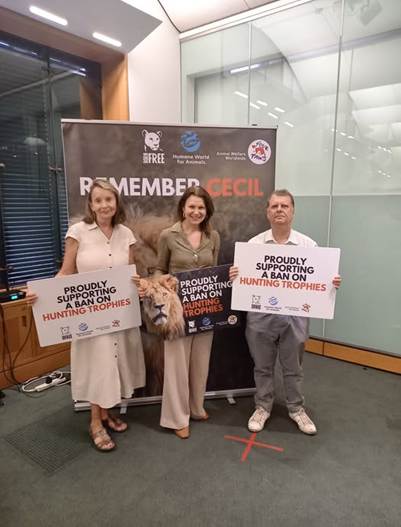
In July we attended an event in the UK Parliament on a new bill which aims to Ban the importation of hunting trophies into the UK.

See our post on this here: https://panorthodoxconcernforanimals.org/uncategorized/trophy-hunting-what-the-evidence-says/.
We also shared a discussion between the AIA’s scientific advisor Dr Andre Menache with famous actor and supporter Peter Egan. Peter Egan Q&A with Dr Andre Menache.
Our President as a private individual, (as Charities are banned from campaigning against animal experimentation), made a significant financial contribution to a major publicity campaign on ending animal experimentation, which informed the public on the modern science on this subject. As you will see later, we believe this campaign put significant pressure on the government to make changes in the law on this subject.
Our representative attended the Oxford Centre for Animal Ethics Summer School which this year discussed the topic of The Ethics of Captivity, What was noticeable was the number of papers being given on industrial fishing. For those of you who have our 2021 book on Climate Crisis and Sustainable Creaturely Care: Integrated Theology. Governance and Justice, you will remember that it contains a chapter on ‘Fish the Forgotten Species’ by Chris Fegan and Gerald Taylor, which gives a good representation of what was discussed this year.

Much happened over these few months, including the writing of chapters based upon the presentations of the POCA panel at the IOTA Conference 2023, for our new book with Holy Cross publications; increasing the numbers involved in helping our group, which include three new members Stephanie Muzekari, who now posts regular and theologically relevant social media postings, Michael Lee our Social Media expert, who trained Stephanie and is developing our new website, and Dr Louk Andrianos, who is a World Council of Churches consultant on the Care for Creation, Sustainability, and Climate Justice. As you can imagine we are absolutely delighted at God’s blessing here. In addition, we are always trying to find interesting ways to reach the public on aspects of animal suffering, and we are unique in this sense.
We also shared this work by Prof Fr. Serafim Seppälä from the University of Eastern Finland, a Philosopher and Theologian, as we are delighted that this subject is now being discussed at this level. See ‘Animals as ἄλογα: A Critical Appraisal of a Murky Concept.’
(61) Animals as ἄλογα: A Critical Appraisal of a Murky Concept
https://doi.org/10.61560/ORTODOKSIA.147640.
His abstract states:
In our times, phenomena such as industrial animal agriculture, increased meat consumption, and the loss of species necessitate an urgent shiſt in human attitudes towards animals. Within the Orthodox Church, there seems to exist some discrepancy concerning different approaches to animals. On the one hand, the ideals and praxis of monastic saints demonstrate a harmonious relationship with animals, supported by the idea of a return to the original paradisiacal state. On the other hand, this seems to have minimal impact on the broader Church, or its teachings. The patristic, hymnographic, and even modern Orthodox discourses are inherently linked with the concept of animals as αλόγα, beings lacking the faculty of reason. Historically, this notion has frequently been used to justify human entitlement to treat animals as objects of consumption and mistreatment. The validity of this argument was debated already in antiquity, and its integration into patristic theology created some tensions with the paradisiacal ideals. The notion of animals as ἄλογα is problematic in several ways related to its semantic ambiguity, inconsistent applications, and practical realities. Therefore, the argument requires reinterpretation in the light of contemporary concerns and modern scientific discoveries regarding animal cognition. This paper seeks to trace and examine the principal uses, applications, and problematic aspects of the idea of animals as αλόγα, focusing on patristic sources with some reference to Greek antiquity, in addition to some insights of modern natural science.
SEPTEMBER
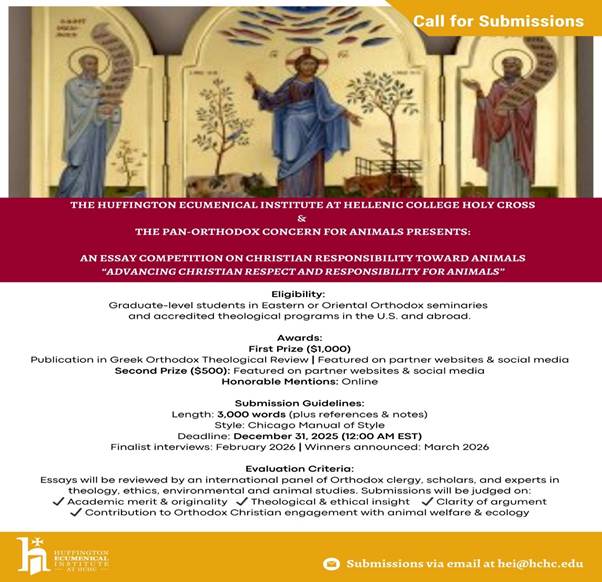
In September we launched our exciting joint venture with the Huffington Ecumenical Institute at the Hellenic College, Holy Cross Seminary, Boston USA. This is new for both groups and we are not sure what engagement to expect but think it worth the effort and money to generate more academic work by Orthodox students on this subject.

Again, in September we were invited along with other faith groups, to sign an open letter to the new Pope urging an update to the Catholic Church’s teaching on Human-Animal relations. The letter can be seen here: https://panorthodoxconcernforanimals.org/uncategorized/christian-animal-advocacy-and-protection-organizations-sign-letter-to-pope-leo-xiv-urging-an-overdue-update-to-the-churchs-teaching-on-human-animal-relations/.
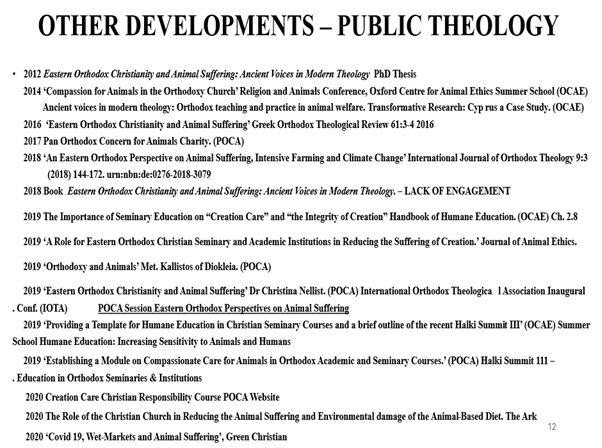
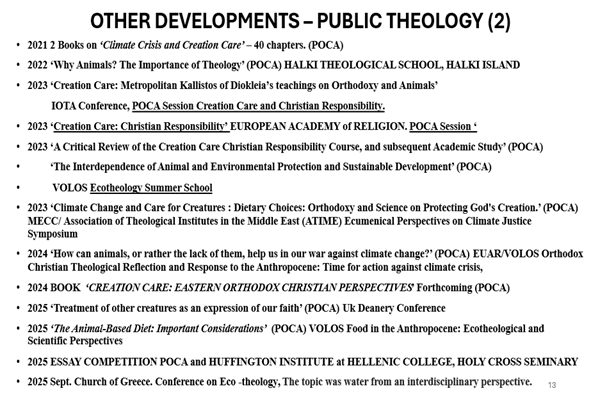
Our President was invited to give a key-note speech in Norway by Professor Tom Sverre Bredal-Tomren at a conference on ‘Ecotheology as an Academic Discipline’, organised by the European Christian Research Network (WW.ECErN.org) and the research group Ecotheology, Sustainability and Education (EcoSE) at VID specialized university. Her talk was titled ‘Orthodox Ecotheology: An Evaluation of Orthodox, Academic & Seminar Engagement and Examples for discussions.’ Dr Nellist surveyed the engagement on the subject by Orthodox theological institutions across the globe and alas in general terms there was virtually no engagement. However, in recent months there has been two important additions to that run by Elizabeth Theokritoff at IOCS in Cambridge, and it is worth noting that one is at the Huffington Ecumenical Institute in the USA, run by Archdeacon Fr John Chryssagis, a former student of Met. Kallistos and an advisor to POCA, and the second by the Volos Academy for Theological Studies and the Orthodox Church in Estonia, which includes a section on Animal Theology, taught by Dr Nicholaos Asproulis, who is Chair of POCA. During the presentation Dr Nellist commented on the ‘Public Theology’ that is being undertaken by POCA and facilitated at times by Orthodox institutions, and here are the two slides detailing the most significant achievements undertaken by POCA these past years.


She noted that whilst a causal link between these academic activities by members of our team and the very recent development/engagement with animal theology cannot be proven,it is widely acknowledged that increasing willingness to engage with hitherto perceived ‘difficult’ subjects, comes via increasing exposure to the subject. As a result of this significant academic work, together with interviews, engagement with other groups such as the Animal Interfaith Alliance in the UK and the Orthodox Fellowship of the Transfiguration in the US, engagement by our POCA team in other countries, such as the Volos Academy in Greece, or the inclusion of our Creation Care Christian Responsibility Course in home-schooling, or information in Diane’s Parish Newsletter in Columbus, Ohio USA, see- https://d.docs.live.net/98e64fa4c0b7a3e8/Documents/POCA%20charity%20comm%20annual%20accounts%20etc/CHARITY%20COMM%20REPORTS/POCA%20YEARLY%20REVIEWS/CGC%20Newsletter%5eJ%20Fall%202025%20(1).pdf –
we believe we are, by God’s grace, making a significant impact in the Orthodoxy academic arena and the wider Christian movement. This will increase as the two new courses develop, and with Dr Nellist’s inclusion in the editing team of a new European journal on Ecotheology starting next year. Her presentation was also requested by one of our new colleagues for his work at the World Council of Churches.
OCTOBER
In October we all received the awful news of the death of the wonderfully inspiriting women Jane Goodall. We were asked to produce a short piece on her influential work. See here:
https://panorthodoxconcernforanimals.org/uncategorized/dr-jane-goodall-with-thanks/.

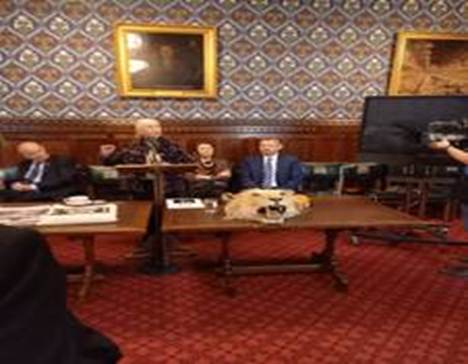
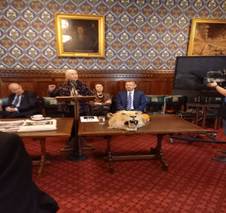
On a personal note, this is my photo of Jane speaking in the Houses of Parliament at the first event to ban trophy hunting imports into the UK. (Apologies for the inferior quality!) Somewhere there is a photograph of Jane and I together taken by the event’s official photographer, which sadly I never received. I am not one for ‘selfies’ but how I regret not doing so that day!
In October we reported that the Farm Assurance scheme known as Red Tractor, has had its advertising banned for making false claims on their environmental practices. POCA was heavily involved with the ecumenical Christian Ethics of Farmed Animal Welfare Research project, funded by the Arts and Humanities Research Council (AHRC) between 2018 and 2022. We evaluated systems according to the opportunities they provide for flourishing with systems graded poor, better, or best available. We found that Red Tractor assurance scheme was the worst in all categories receiving Poor as its standard score across all types of animals farmed. Frankly, it is not worth the paper it is written on and despite what the farming lobby would have you believe, the report states ‘We conclude that production systems that provide poor opportunities for farmed animals to enjoy flourishing lives are inadequate.’ The government and farming bodies should withdraw this failed assurance scheme and ‘work for legal, regulatory, and trade changes that raise farmed animal welfare systems.’ One obvious suggestion would be to take advice from independent bodies like the RSPCA who have no vested interests in the present system to create a credible scheme. You can order a copy of the report here cefaw@abdn.ac.uk
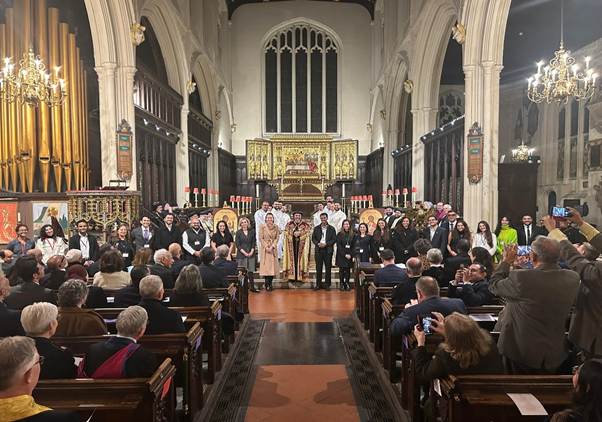
Also in October, it was a great honour to receive an invite from His Eminence Archbishop Angaelos to their Nayrouz Service at St Margaret’s, Westminster Abbey, where we also heard messages from His Majesty King Charles III, The Archbishop of York, and The Prime Minister.

We were also contacted by two Greek Orthodox sisters from America, Lexi & Zoe Doukakis, who have written and illustrated a children’s book titled Why did God make Beasts & Bugs? We were also delighted to receive a copy, and our team discussed it at that month’s meeting. We are pleased to say that we all found it delightful. The style and language are age appropriate, and the illustrations are delightful. It begins with a page that commemorates St Gerasimus of the Jordan, pictured with the famous injured lion. We are told that St Gerasimos was filled with love and compassion for the suffering lion, who in turn felt such gratitude and love for the saint that he became his loyal companion for the rest of his life. We are then taken through a story of a young boy, his mother, and other creatures, many of whom are not the cute fluffy ones that Met. Kallistos speaks of, but those who may at times scare us. Throughout the story we are reminded of the goodness that the animal’s carry, and end with the little boy thanking God for the beasts and bugs, “for it is your love that I see in them.” We can certainly recommend this to all of you with young children or grandchildren – see contact details here.
NOVEMBER
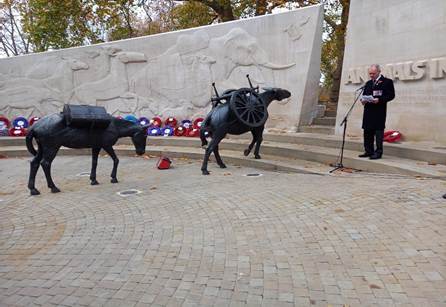
In early November, a POCA representative laid two wreaths at this year’s Animals War Memorial service in London in honour of all the animals who served and died in human conflicts. One was from POCA, the other as a representative of the Animal Interfaith Alliance, where we have a seat on their Board of Directors. This is an outdoor faith-based service with hymns and prayers and the opportunity to lay wreaths. The service was conducted as usual by the Revd Samantha Chandler.

See our report here: Animals in War Memorial 2025 – Pan-Orthodox Concern for Animals
Also in November, we reported that the Labour government published its long-awaited ‘Replacing Animals in Science Strategy,’ marking a major step toward ending cruel and outdated animal experiments. This strategy sets out a vision for accelerating the use of modern, non-animal research methods. Sadly, there will still be the provision for animal experiments, so we must continue with our efforts. What is needed now is a timeframe for implementing those plans, as the vested interests will not change without government enforcement. We can celebrate that the government has at last accepted 21st century science and recognized the failed Animal Testing Model for what it is – the misuse of God’s good creation.
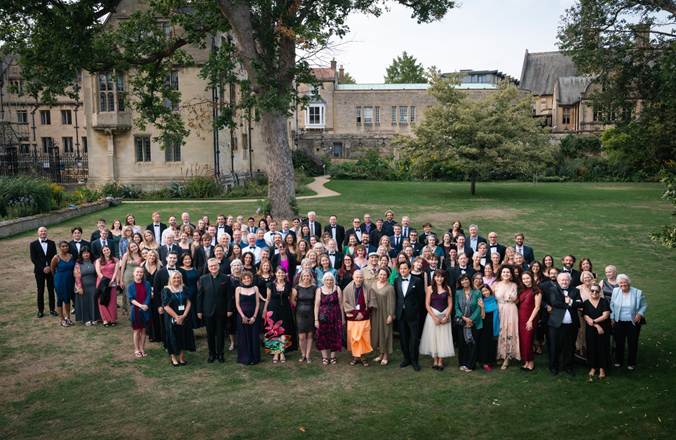
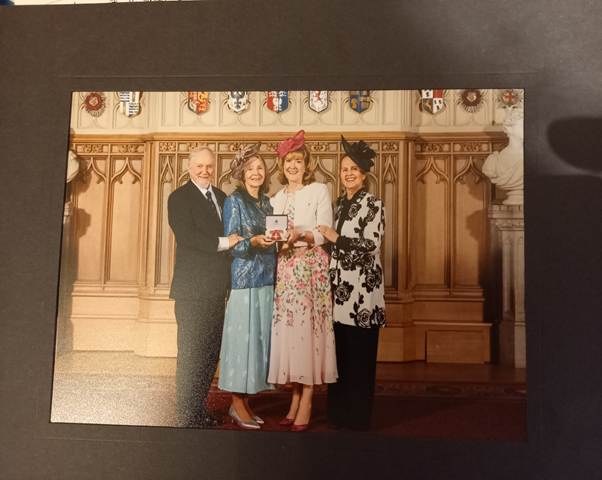
It was also a great privilege to be invited to Windsor Castle by our dear friend and colleague Barbara, head of the AIA, when she received her MBE from King Charles 111, for her work in Animal Welfare. It was a wonderful, joyous day, and a rare event for those of us who have devoted our lives to the suffering of animals, as each of us in the group photo have done.

Barbara is the beauty in white. We thank you Barbara for involving us in your day and we celebrate our ecumenical ties with the other faith groups in the Animal Interfaith Alliance who are all working to the common goal of reducing the suffering of God’s other creatures.
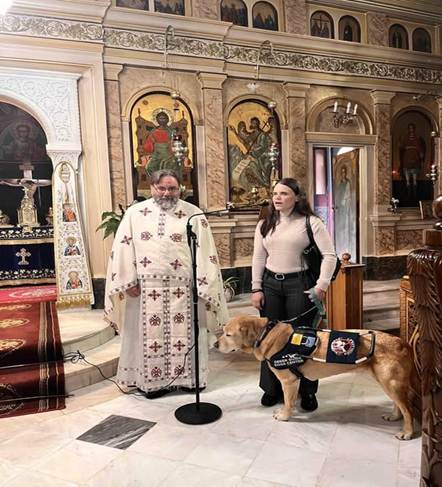
At the end of November, we received good news and a photograph from one of our team, Fr Dimitrios in Greece, that he had conducted the liturgy in his Church with one of his parishioners and her support-dog. It can be done, and is being done both in Greece and America, was undertaken in the UK when Fr Simon was alive, and it would be good to know of other countries.

DECEMBER
In early December we received another email from a family who found great comfort from our ‘Prayer for the Death of a Companion Animal’ just at the moment their animal was leaving them. Here is their first sentence in a long and detailed email:
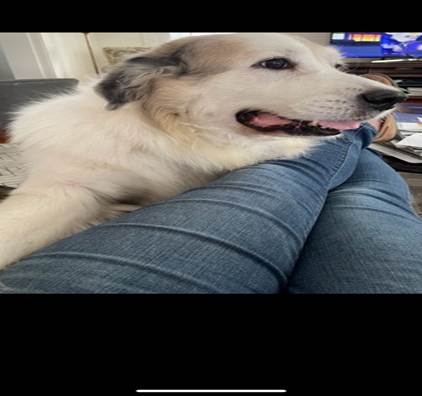
“I want to thank you for posting this prayer. It was the last thing our beloved Great Pyrenees, Snoe, heard before she passed away, mid prayer. In a way, perhaps it was God’s mercy to me, confirming He has her and that it was her time.”
See https://panorthodoxconcernforanimals.org/prayers-for…/
Advice was also sought on the depth of their grief. We responded and received this affirming email in response, along with photos of their beloved dog:
Good Evening,
Thank you so much for taking the time to reply and for your kind words. It means more than you know that you took the time to reply to me, and your words are a great comfort: I’ve re-read your email several times and each time I cry, not so much out of grief, though there is that too, but because I’m so touched by your kindness. When the weather is warmer, I’ll plant a rose bush. I love that idea. I’m attaching some photos of dear Snoe, and please feel free to share my comments. You may need to crop some of these a little.
Thank you again.
With love and gratitude…

Perhaps today you might consider including prayers for the end of animal suffering in all its forms.
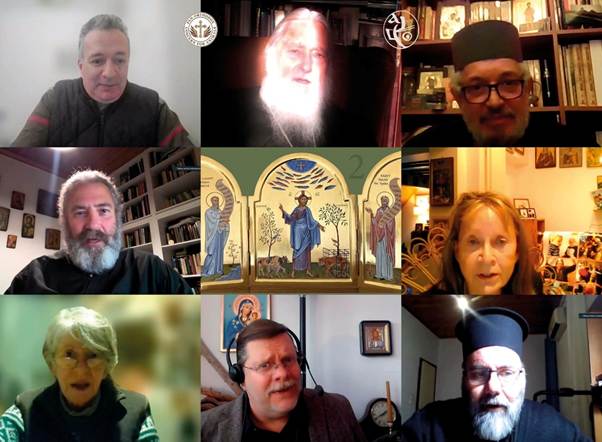
On December 9, 2025, the second Webinar organized by the Pan-Orthodox Concern for Animals (POCA), in cooperation with the Volos Academy for Theological Studies, was successfully convened. The session focused on Metropolitan Kallistos’ (Ware) recollections of his encounters with animals.
The POCA panel featured distinguished speakers, namely Rev. Prof. Andreas Andreopoulos (King’s Foundation School of Traditional Arts, UK, shown left in middle row), Dr. Elizabeth Theokritoff (Institute for Orthodox Christian Studies, Cambridge, UK, bottom left), and Dr. David Goodin (Laval University, Canada, bottom middle). Using previously unreleased video footage, recorded for POCA by another member of our team, James, the panellists discussed themes raised by the late Metropolitan Kallistos concerning his interactions with cats, lynxes, and wolves.

The Webinar commenced with an opening prayer for animal care offered by Fr. Dimitrios Zacharopoulos (bottom right) ,who also conveyed the official blessings of Archbishop Hieronymos of Athens and All Greece. A brief introduction to the topic and the POCA activities was provided by its founder and president, Dr. Christina Nellist. Following each video presentation, the panellists offered expert commentary. Discussions centred on the profound relationship between humans and animals; the specific care monastics have historically demonstrated toward animals on Mount Athos (drawing on stories recounted or written by Metr. Kallistos) and the overarching need for an inclusive ethos that recognizes animals as “fellows” to humans. The Webinar concluded with teachings by one of POCA’s patrons, His Grace Metropolitan Seraphim of Zimbabwe and Angola, (top right), a personal reflection of Fr Simon, one of our co-founders, and a final prayer for the welfare of both humans and animals. The Webinar was moderated by Dr. Nikolaos Asproulis, Deputy Director of the Volos Academy for Theological Studies, and Chair of POCA(top left). The video-recording of the event is available here: https://www.youtube.com/watch?v=vuNQxYFtwu4

There was more good news and hope for serious reductions in animal suffering for animals in the UK, as the government announced its national ‘Animal Welfare Strategy.’ If this, or even part of it is delivered, it will significantly impact the lives of millions of animals every single year. There is:
- A pledge to end high-intensity CO₂ gassing of pigs at slaughter, which causes agonising acid to form in their eyes, lungs, and noses.
- An end to cruel cages for hens and mother pigs.
- A commitment to introduce slaughter protections for farmed fish.
- Action for chickens bred for meat, whose unnaturally fast growth leads to broken legs and heart attacks.
- Support for the egg industry to stop killing male chicks, deemed ‘worthless’ because they don’t lay eggs.
- Banning Trail-hunting is also on the agenda.
And underpinning all of this: real enforcement — so laws are not just words on paper, but protections that animals actually experience. We like so many other groups and individuals who have worked for decades to reduce the suffering of animals, will continue to monitor the government’s progress and push for a period to ensure these pledges come to fruition before the next election.
Finally, as we end this Review, we add a note to say that we have closed one of our pages to make it less confusing and we shall be revealing a new website in the new year.
Our group consists of well-respected Orthodox theologians, ethicists, academics and laity, whose mission is to promote Christian respect and responsibility for the animal creation through Eastern Orthodox teachings. We also believe that all peoples have the right to freely exist and to be treated with love, compassion, and respect. We began in 2017 and are a Charity.
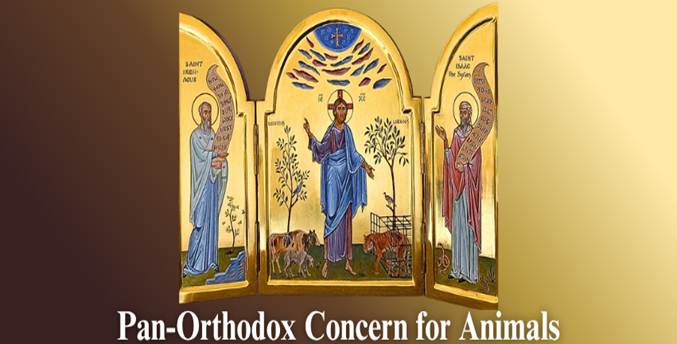
As a cautionary note, the Icons for our group are as follows:

And this

We thank you all for your support throughout these years, and we work hard to gain your respect and trust.
From every one of the POCA team, we send you love and blessings for a peaceful and healthy New Year.