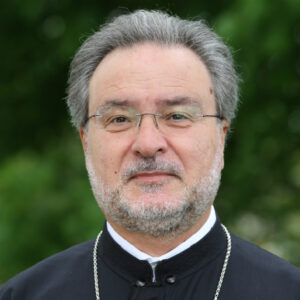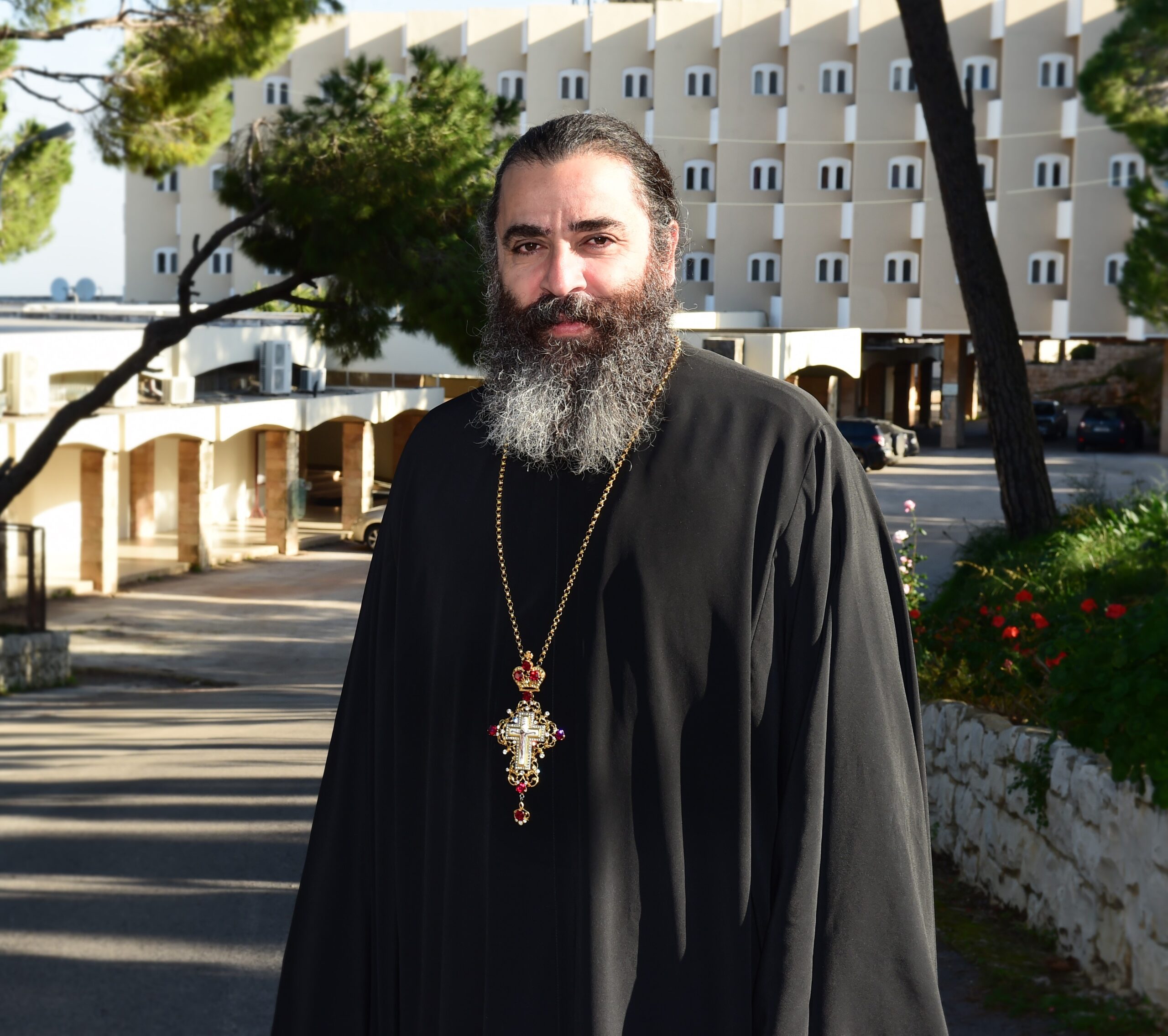
Ecological Metanoia from our ecological sins, by His Eminence Metropolitan of Zimbabwe Serafim Kykotis

This is an important statement on ecological metanoia by His Eminence Met. Serafim. The English text is coming soon:

Οικολογική μετάνοια από τις οικολογικές μας αμαρτίες


Του Σεβ. Μητροπ.  Ζιμπάμπουε Σεραφείμ

Στη σημερινή Ευαγγελική Περικοπή (Ματθαίου 4, 18 – 23) βλέπουμε πως τέσσερις από τους σημαντικότερους Μαθητές του Χριστού, στην κλήση τους να τον ακολουθήσουν, εγκαταλείπουν τα πάντα χωρίς δισταγμό κι αμφιβολία. Θυσιάζουν τα πάντα για να γίνουν Μαθητές του Χριστού.

Μέσα στη παγκόσμια κρίση που ζούμε με Πανδημίες και οικολογικές καταστροφές του Πλανήτη μας, ίσως πρέπει να προσθέσουμε στην σημερινή ευαγγελική περικοπή και το χωρίο Ματθαίου 4,17 που πολύ σοφά ο Απόστολος Ματθαίος το έχει ως εισαγωγή στην σημερινή ευαγγελική περικοπή, που φαίνεται πριν πολλά χρόνια, αυτοί που καθιέρωσαν το Τυπικό των περικοπών το απέκοψαν. Το χωρίο αυτό είναι πολύ σημαντικό για πολλούς λόγους, πρώτον, τονίζεται ότι αρχίζει η έναρξη του δημόσιου κηρύγματος του  ο Ιησούς και δεύτερο, το πρώτο πράγμα που τονίζεται είναι η «Μετάνοια» και η Βασιλεία των Ουρανών από τότε ήρξατο ο Ιησούς κηρύσσειν και λέγειν, μετανοείτε ήγγικε γαρ η Βασιλεία των ουρανών»). Το κήρυγμα της Μετανοίας, ως νέος τρόπος ζωής και νέος τρόπος σκέψεως, είναι και  το πρώτο πράγμα που τόνιζε κι  ο άγιος Ιωάννης ο Πρόδρομος, που με τη Πρόνοια του Θεού προετοίμασε την οδό του Ιησού Χριστού. Το κήρυγμα της Μετανοίας το τονίζει κι ο Απόστολος Πέτρος την Ημέρα της Πεντηκοστής, που θεωρείται η Γενέθλιος Ημέρα της Εκκλησίας («μετανοήσατε» Πράξεις 2,38). Η ζωή της πρώτης χριστιανικής κοινότητας που άρχισε να ζει εν μετανοία αποτελεί το ζωντανό παράδειγμα και για την σύγχρονη κοινωνία για να προστατευθούν τα θύματα των προβλημάτων της κλιματικής αλλαγής από τις οικολογικές μας αμαρτίες («κανείς δεν έλεγε ότι κάτι από τα υπάρχοντα του είναι δικό του, αλλά ήσαν εις αυτούς κοινά…. και δεν υπήρχε κανένας φτωχός μεταξύ τους» Πράξεις Αποστόλων 4,32 – 34). Το κήρυγμα της Μετανοίας  τονίζεται ξανά την ημέρα της Αναλήψεως του Ιησού εις τους ουρανούς («κηρυχθήναι επί τω ονόματι Αυτού μετάνοιαν» Λουκά 24,47). Η επιστημονική Κοινότητα του Ο.Η.Ε. για τα προβλήματα της Κλιματικής Αλλαγής τονίζει τον ανθρώπινο παράγοντα ως τον κύριο υπεύθυνο για την μόλυνση της ατμόσφαιρας και τις οικολογικές καταστροφές που απειλούν την επιβίωση της Ανθρωπότητας και τη καταστροφή του Πλανήτη μας. Ο μόνος τρόπος να αλλάξουν τα πράγματα για να προστατευθεί η Ανθρωπότητα και η ελπίδα για το μέλλον του Πλανήτη μας είναι να μετανοήσουμε από τις οικολογικές μας αμαρτίες και να αρχίσουμε να ζούμε ένα νέο τρόπο ζωής με ένα νέο τρόπο σκέψεως, όπως τους Αποστόλους του Ιησού Χριστού. Να προστατεύουμε τους συνανθρώπους μας και την όλη Δημιουργία του Θεού ως δώρο για όλες τις γενεές. Ο άγιος Ιωάννης ο Πρόδρομος μας καλεί «να ποιήσουμε καρπό άξιο της μετανοίας», (Ματθαίου 3,8) ,με την καλοδιάθετη απόφαση μας να μοιραζόμαστε αυτά που έχουμε με αυτούς που δεν έχουν τίποτα («εκείνος που έχει δύο χιτώνες να δώσει εις εκείνο που δεν έχει και εκείνος που έχει τρόφιμα να κάνει το ίδιο» (Λουκά 2,11).

Στο βιβλίο της Γένεσης που περιγράφεται η Δημιουργία του κόσμου και ο κατακλυσμός του Νώε, τονίζεται με σαφήνεια ότι τα αίτια της καταστροφής του Πλανήτη μας προέρχονται από τη διαφθορά των ανθρώπων, δηλαδή από τις κάθε είδους αδικίες που διαπράττουμε προς τους συνανθρώπους μας (Γένεση 6,10-13).

Η Εκκλησία μας για να συνεχίσει σήμερα το έργον της με επιτυχία χρειάζεται ανθρώπους με τις ίδιες αρετές και με την ίδια αυτοθυσία όπως τους Αποστόλους μας. Αυτό όμως είναι μόνο η μία διάσταση της επιτυχίας της Εκκλησίας μας στο σωτηριολογικό της έργον. Η δεύτερη πραγματικότητα που πρέπει να χαρακτηρίζει τη ζωή της Εκκλησίας μας είναι η διάσταση της οικουμενικότητας και παγκοσμιότητας του χαρακτήρα του Ευαγγελικού της  έργου, όπως σήμερα βλέπουμε να αναπτύσσεται η Ιεραποστολική μας διακονία εις τα πέρατα της Οικουμένης.

Η δεύτερη λοιπόν διάσταση του σωτηριολογικού έργου της Εκκλησίας μας είναι η συνεχής προσπάθεια της να μεταφέρει το Ευαγγελικό μήνυμα της Μετανοίας και σωτηρίας προς όλους τους ανθρώπους, προς όλες τις Εθνότητες, σε μαύρους και λευκούς, σε μικρούς και μεγάλους, σε όλες τις φυλές της γης και να βοηθούμε και να προστατεύουμε τα ορφανά και τις χήρες, τους καταδιωγμένους και τους αδικημένους, τους φτωχούς, τους ασθενείς, τους πρόσφυγες και τους μετανάστες, τους ασθενείς και τους ηλικιωμένους,  τους ανάπηρους  κι όλα εκείνα τα αθώα παιδάκια που πάσχουν από το φάσμα του αυτισμού ή άλλα συμπτώματα που δεν φέρουν καμία ευθύνη.

Ο βίος μας είναι κοινός και μπορούμε να κάνουμε τη ζωή μας όμορφη αν αφήσουμε χώρο στην καρδιά μας να βασιλέψει η Μεγάλη μορφή του Χριστού  με την άδολη αγάπη μας και τη φιλανθρωπία μας και τη καλοσύνη μας προς κάθε κατεύθυνση. Μόνον αν αφήσουμε στη ζωή μας να μας καθοδηγεί ο Χριστός έχουμε ελπίδες για να ζήσουμε σε ένα καλύτερο κόσμο που θα μας οδηγήσει και στην αιωνιότητα του Παραδείσου.

Στην έναρξη λοιπόν του δημόσιου κηρύγματος του Ιησού και στη κλήση των πρώτων του Μαθητών και Αποστόλων, τονίζεται η Μετάνοια και η Βασιλεία των Ουρανών, με ζωντανό παράδειγμα και της δικής μας καθημερινής ζωής, τη διακονία των αγίων Αποστόλων.

Γι’ αυτό στη σημερινή αποστολική περικοπή (Ρωμαίους 2, 10 – 16) , ο Απόστολος Παύλος τονίζει ότι «είναι δόξα και τιμή για τον κάθε άνθρωπο που κάνει το καλό» . Όσοι δεν ζουν εν μετανοία, όπως συνέβη με το Ζακχαίο που έδειξε την μετάνοια του με την αλλαγή της ζωής του,  με   την αποκατάσταση της κοινωνικής δικαιοσύνης για τις κοινωνικές του αδικίες, μοιράζοντας τα υπάρχοντα του με αυτούς που αδίκησε  Λουκά 19, 1- 10).

Ο Απόστολος Παύλος μας λέει στην σημερινή Αποστολική περικοπή, ότι όλοι οι άνθρωποι του Πλανήτη μας , θα  κριθούν αν είναι άξιοι για τη  Βασιλεία των ουρανών με τρία κριτήρια .  Οι Εβραίοι αν είναι υπάκουοι στον Μωσαϊκό Νόμο, οι Χριστιανοί, στις εντολές του Χριστού, αν προστατεύουμε τους πάσχοντες και τους αδικημένους και την όλη Δημιουργία του Θεού, ιδιαίτερα το Πλανήτη μας,    από οικολογικές καταστροφές, κι   όλοι οι άλλοι με κριτήριο τη συνείδηση τους, με την έννοια ότι μπορούν να κρίνουν το καλό   από το κακό και το άδικο από το δίκαιο.

Τελικά, η οικολογική μας μετάνοια από τις οικολογικές μας αμαρτίες, ως ένας νέος τρόπος ζωής, να ζούμε χωρίς να μολύνουμε το Πλανήτη μας και να αδικούμε τον συνάνθρωπο μας με τις κοινωνικές μας   αδικίες , είναι μονόδρομος για τη προστασία της Ανθρωπότητας  και την επιβίωση του Πλανήτη μας , ως δώρο Θεού για όλες τις γενεές, και μάλιστα γι’ αυτές που ακόμη δεν έχουν γεννηθεί, που αν συνεχίζουμε να ζούμε με τον τρόπο που ζούμε, πάμε να τους κληρονομήσουμε μια ζωντανή κόλαση και στη Γη.   

Daily Reading Programme on the Care for Creation

A Daily Reading Program on the Christian Theology of Creation
The Unified Vision and Spiritual Direction of the Orthodox Patriarchs as they
call us into care for God’s Creation
A Program of Theological Reflections on Christian Responsibility for
the Care and Keeping of God’s Creation

The Orthodox Fellowship of the Transfiguration

June 1-30, 2021

Introduction
Christ is risen! Greetings in of Lord Jesus Christ! Throughout 2020 the Orthodox
Fellowship of the Transfiguration every month published a set of readings from the
patriarchs and top hierarchs of the Orthodox Church across all jurisdictions that
featured their statements on the proper care of God’s creation.
Now, after several requests that the OFT resume this service, yes, we will
restart this service with a new set of readings from the Patriarchs and Hierarchs of
the Church. These statements are united in that they all call for the care of creation
so that Orthodox parishes may engage the pressing issues of our time. Besides, care
for the creation is more than concern for the environment. This is because care of
the earth serves as a “doorway” to an Orthodox way of life. It provides a gateway to
a genuine Orthodox lifestyle that at once is in harmony with the commandments,
with theology and creation as a visible icon of the divine economia.
As a further consideration, in past centuries humans could not alter the face
of the planet or unleash massive destruction upon the earth. It was not necessary in
those times to emphasize the biblical mandates to respect the earth. In our day with
new and expanding capabilities our top hierarchs are reacquainting us with our
ancient God inspired responsibility to connect our vision of Christ and the Holy
Spirit in all things to respect for creation as worthy of reverence and all care.
As our patriarchs and bishops restore awareness of our duty to respect creation,
we should give special thanks as they restore a vision of holy regard for all things. In
this way, they are laying out an inspired pathway to help us overcome the
secularism and individualism that are diametrically opposed to Orthodox
Christianity.
Thus it is not insignificant that the Orthodox patriarchs across jurisdictions
have become virtually unanimous in a common unified calling for our Church to
awaken to its biblical responsibility and theological vision to assume and restore
responsibility for the planet and the way we relate to the earth.
As you read these statements from our top bishops, an unusual opportunity
emerges. You can let the inspiration upon our holy patriarchs become your teachers
in the faith and instructors in how Orthodox Christians can reshape our lives
despite the deepening secularism which surrounds us.
Yours in service to God’s good earth,
MR – ERC – FK The reading-a-day editorial team

1 Tuesday June 1, 2021 Reuniting the Universe Under Jesus Christ
Cosmology is a form of knowledge which is given to us in Christ by the Holy
Spirit. “The mystery of the Incarnation of the Word,” wrote St. Maximos the
Confessor, “contains within itself the whole meaning of the created world. He
who understands the mystery of the Cross and the Tomb knows the meaning
of all things, and he who is initiated into the hidden meaning of the
Resurrection understands the purpose for which God created everything from
the very beginning.” If this is so, it means that everything has been created by and for the
Word, as the Apostle says in Colossians 1:16-17, and that the meaning of this
creation is revealed to us in the re-creation effected by the same Word taking
flesh, by the Son of God becoming the son of the earth….
In this perspective the Fathers maintain that the historical Bible gives us
the key to the cosmic Bible. In this they are faithful to the Hebrew notion of
the Word, which not only speaks, but creates: God is “true” in the sense that
his word is the source of all reality, not only historical, but also cosmic
reality…. That is why, as St. Maximos says, we discover, or rather the Gospel
discovers for us, that on the one hand, the Word “hides himself mysteriously
in created things like so many letters,” and on the other hand, “he… expresses
himself in the letters, symbols and sounds of Scripture.”
HB Patriarch Ignatius IV of Antioch, Zurich, Switzerland,
March 10, 1989
Q
What does the term ‘cosmology’ mean?
How much can you explain what is called ‘the Incarnation of the Word’?
How does this relate to the created world?
Reflection


2 Wednesday June 2, 2021
A Call to Protect God’s Creation

The Orthodox Church appreciates these efforts to overcome the ecological
crisis and calls people to intensive co-operation in actions aimed to protect
God’s creation. At the same time, she notes that these efforts will be more
fruitful if the basis on which man’s relations with nature are built will be
not purely humanistic, but also Christian.
One of the main principles of the Church’s stand on ecological issues
is the unity and integrity of the world created by God. Orthodoxy does not
view nature as an isolated and self-enclosed structure. The plant, animal and
human worlds are interconnected.
In the Christian view, nature is not a repository of resources intended
for egotistical and irresponsible consumption. Rather, it is a house in which
man is not the master, but a housekeeper. It is a temple in which he is the
priest serving not nature, but the one Creator. The conception of nature as a
temple is based on the principle of theocentrism: God Who gives to all “life,
and breath, and all things” (Acts 17:25) is the Source of being. Therefore,
life itself in its various manifestations is sacred, being a gift of God. Any
encroachment on it is a challenge not only to God’s creation, but also to the
Lord Himself.
HB Patriarch Kyrill, Archbishop of Moscow and Patriarch of All-Russia,
Statement of the Russian Orthodox Church on Ecological programs, #4, June 1, 2012. Q
What are the Orthodox Christian foundations for action to heal God’s earth?
How might a person help protect the earth? List the different ways.
What is the practical meaning of each person as a priest of creation?
Reflection


3 Thursday June 3, 2021
An Awakening to our Problems is Essential

Unless everyone is made sensitive to the harmful character of [polluting]
actions, it is almost impossible for any endeavor for the improvement of the
[environmental] situation to succeed.
Religion can inspire the behavior of every individual or even mass
movements; and it is able to transmit and spread the necessity and benefit of
these behaviors.
This sense of a common fate, which is the polar opposite of the
widespread individualistic and self-interested perception which is short-sighted
in its appreciation of the world, is a basic teaching of the Christian faith, and
especially of Orthodoxy.
Let us seek … to energize the feelings of inertia about responsibility for
the common good which we find in individuals and in whole peoples.
We call on every conscience to awaken! We invite you to a virtual
apostolic commission to spread the word about the necessity for a common
confrontation of these problems. The grace of God be with you all.
HAH Ecumenical Patriarch Bartholomew, Trabzon, Turkey,
September 20, 1997
Q
How do people awaken to the seriousness of ecological problems?
Why should every Christian become sensitive to these issues?
What does it mean to have an apostolic commission to spread the word?
Reflection


4 Friday June 4, 2021
The Human Role in the Cosmos

Man is a mediator. He is poised between two realities – God and the world.
He shares in both, he is united to both. He cannot live apart from either.
That is the meaning of the incarnation of Jesus Christ. The only humanity
that can survive is the new humanity, the humanity that has now been
inseparably, indivisibly united with God in Jesus Christ.
The new humanity is a mediating humanity – a humanity that
reconciles and unites God and the world. It is an incarnate humanity – a
humanity that is an inseparable part of the whole creation and inseparably
united to the Creator.
This is the meaning of the human presence in the cosmos. To be with
the one who unites. To be in Christ, uniting the divine and the human, the
Creator and the creation, the transcendent and the immanent, the spiritual
and the scientific-technological. To enter the mystery of “Christ in us,” yes, in
us Christians, but also in us human beings, and in us as an integral part of the
whole creation.
The subtle art of image making for the future needs skilled craftsmen
as well as the gift of the Spirit. The various crises of our time should be used
neither as occasions for doom-saying pessimism nor as a chance to peddle
empty-hope optimism. Every crisis is a judgement, a call to see where things
have gone wrong and to seek to set matters right, both within our
consciousness and in society.
The environmental crisis, the economic crisis, the crisis of justice, the
crisis of faith…, the crisis of militarism – of all of these are symptoms not only
that humanity has yet to become what it has to be, but also that it is on the
wrong track.
HE Metropolitan Mar Paulos Gregorios,
Syrian Orthodox Church of India,
New Delhi, India, 1987
Q
What does it mean that humans are mediators?
How is a mediating humanity akin to humans as priests of creation?
Why are crises messages to society?
Reflection


5 Saturday June 5, 2021
Modernity and Global Climate Change

Modernity confronts us with many dilemmas. Man must answer challenges, and
not only those for which his teachers prepared him, but also totally new and
different problems that life places before us. And it has always been so.
The technological progress and social innovations of the 20th century have
transformed the world much faster than, for instance, the entire process of
technological development during medieval times.
Respected theologians of the Serbian Orthodox Church are [now] raising
serious concerns about the environmental crisis and the urgent problems of global
warming, floods, forest fires, sea pollution from plastics, climate changes, etc. …
What is expected of contemporary Christians, as responsible members
of Christ’s Church, is neither aloof diagnosing of spiritual “illness” nor
pronouncements of the “ruination of the world,” nor panicked anathematizing
of “this world” and its modernity, but a responsible witnessing of the Truth of
God-Man Christ, and an unmasking of all falsities, misconceptions and injustices
through the love of Christ.
We have a crucial role as Orthodox Church in encouraging the world’s
response to the climate and ecological crisis through Church as Body of Christ….
Let us all recall the commands of God regarding our use of the earth…. Let us
respond to the divine commandments so that the blessings of God may be
abundantly upon us in Liturgy and prayers. And let us responsibly discern the
right, holy and proper way to live in this time of change and challenge, as a life in
Church as a Body of Christ.
HB Patriarch +Irinej, Serbian Orthodox Church,
Belgrade, September, 2020,
Q
Why is climate change happening?
What role might the Church play in addressing this issue?
What is the call of Scripture in caring for the earth?
Reflection


6 Monday June 7, 2021
Why Ecology is a Spiritual Issue

The ecological problem is, at root, a spiritual issue. Many people dealing with
it tend to overlook its spiritual aspects. And yet both historically and from
the practical point of view it is impossible to address it without reference to
religion and ethics. …
A human is the Priest of creation as he or she freely turns it into a
vehicle of communion with God and fellow human beings. This means that
material creation is not treated as a means of obtaining pleasure and
happiness for the individual, but as a sacred gift from God which is meant to
foster and promote communion with God and with others.
Such a ‘liturgical’ use of nature by human beings leads to forms of
culture which are deeply respectful of the material world while keeping the
human person at the centre.
HE Metropolitan John of Pergamon, “Production and Consumption,”
April, 1996
Q
Why is the ecological problem a spiritual issue?
Can you explain what are the duties of a ‘priest of creation’?
How does a sense of the sacred in nature lead to a liturgical sense about nature?
Reflection


7 Tuesday June 8, 2020
Energy Conservation and Climate Justice

In light and wind, in land and water, energy resources are abundant gifts for
human well-being from our Creator God. Because we are called to “till and to
tend the garden” (Gen 2:15), we have a moral obligation to choose the safest,
cleanest and most sustainable sources of energy to protect and preserve God’s
creation. Energy conservation is faithful stewardship.
Humans have a choice of priorities for the future. By depleting energy
sources, causing global warming, fouling the air with pollution, and poisoning the
land with radioactive waste, a policy of increased reliance on fossil fuels and
nuclear power jeopardizes health and well-being for life on Earth.
On the other hand, by investing in clean technology, renewable energy,
greater vehicle fuel efficiency and safer power plants, we help assure sustainability
for God’s creation and God’s justice. Energy conservation is intergenerational
responsibility….
Energy policy must be an instrument of social and economic justice here
and abroad. The first beneficiaries of a new energy policy should be “the least
among us,” the low-income, the vulnerable, and the sick to whom we can provide
assistance with high energy bills, inexpensive mobility through expanded mass
transit, cleaner air by reducing pollution from power plants, and lower gasoline
prices through strict monitoring of oil companies for price-gouging. Energy
conservation is justice for all peoples and nations.
There is no single solution to the energy challenge. We do not have to
sacrifice economic security to assure ecological health. Prudence – the application
of moral principle in service to the common good — should guide us to meet
immediate needs in such a way as to enhance, not diminish future sustainability.
HE Archbishop Demitrios, Greek Orthodox Archdiocese of America;
HE Metropolitan Philip, Archdiocese of North America, Antiocian Orthodox Church;
HE Metro. Christopher, President, Episcopal Council of SCOBA, Serbian Orthodox Church;
HE Archbishop Mor Cyril Aphrem Karim, Patriarchal, Syrian Orthodox (Malankara) Church of Antioch;
HB Metropolitan Theodosius, primate, Orthodox Church in America (OCA);
“Moral Reflection on Energy Policy and Global Warming,” Joint declaration, February, 2002
Q
Why should Orthodox Christians be concerned about global climate change?
How does Christianity shape our attitude toward energy use?
How is there a connection between energy conservation and justice?
Reflection


8 Wednesday June 9, 2021 Creation as an Integrated Whole
Orthodoxy’s rich creation theology rests on the assumption that the entire
cosmos is an integrated whole….
Orthodoxy’s understanding of the human being as person, and as a
microcosm of the cosmos, assumes that humanity is existentially meaningful
only through the free and conscious engagement in relation with others. The
Ecumenical Patriarchate is committed to transforming the human condition.
Our vision of freedom and relationality is consistent with U.N. efforts
at transforming post-conflict situations, by restoring the torn fabric of
individual and community life.
The Orthodox Church transcends linguistic, ethnic and national
divisions. Our Holy Orthodox Church is modeled on the Trinitarian
principle of unity in diversity, whereby heterogeneity and uniqueness are
fundamental aspects of our humanity. …
We exhort you, to take up the responsibility which has been given to
us by God, our Creator, to collectively renew our commitment to restoring
the peace, justice and integrity of all creation. We ask you to consider the
creative gifts of the Orthodox Christian community as a resource for change.
HAH Ecumenical Patriarch Bartholomew, United Nations Luncheon,
New York City, NY, October 27, 1997
Q
What does it mean that the human is a microcosm of the cosmos?
How does the term “unity in diversity” reflect the Orthodox Church?
How may we play a role in restoring justice, peace and integrity within creation?
Reflection


9 Thursday June 10, 2020
Respect for the Animals

From time to time we realize that everything is from God, the animals, the
plants, the earth, the celestial planets, and we are humbled before God and
thankful for his creation….
It is traditional for us as Orthodox to have a good relationship with
the animals. Our theology is favorable to the animals. We have never
tolerated violence, but we have never said anything because I think it
was not seen as necessary. Now, however, we see more and more the ill
treatment of animals and it is true, it is time that we in the Church said
something. Before there did not seem the need, but it is different now.
In the context of Cyprus we can do more and we should do more.
Now when we see instances of violence or people bring us information, we
must do something about it.
It is true that many of our teachings do not get through to the
people, but this is true of many other things as well as the animals. It
has to do with the nature of the individual person; some will listen
and understand, while others will go their own way, against the teachings.
If you are a good Christian, you will love the animals and they will love you
back. There are many books showing this through the lives of the early saints.
You cannot find a holy man who has mistreated animals….
Let me be clear. Animals are the creation of God. We should treat
them with respect and not be cruel to them. What kind of soul they may
have has no part of that discussion. We should not be involved in this
type of argument as it only serves to confuse what should be very clear.
We should not be cruel to animals. We should treat them with love.
HE Metropolitan Isaias of Tamasou and Orinis, Orthodox Church of Cyprus,
Interview with Presbytera Christina Nellist, March 4, 2014
Q
Why should Christians respect animals?
How would you describe an Orthodox Christian attitude toward animals?
Do you know how the saints treated animals? What does that teach us?
Reflection


10 Friday June 11, 2020
The Continuing Work of the Church

From my heart I pray for all the workers and Missionaries of the love of
Christ, the Metropolitans and Bishops of the Patriarchate of Alexandria and
All Africa, the Priests throughout Africa and our blessed children, Greeks,
Arabs, Africans, Serbs, Russians and Romanians, Bulgarians, Ukrainians and
all other nationalities, that the Grace of the Most Holy God will strengthen
your lives always.
Now that a new period of Missionary and Catechetical work is about
to start, we are all geared towards sowing and harvesting of the Word of God
in the hearts of the people. The evangelization of the nations, the teaching of
the people of God regarding the important issues of faith and Christian life,
the great problems of the world and society, joblessness, narcotics, diseases,
wars, the ecological problem, destruction and pollution of the environment
and many others, create in us all a huge problem and an internal need for
prayer, strong prayer, so that solutions can be found for all levels.
Having our faith in Christ as a rule, the joy and optimism which stem
from this perspective, we will continue with the “good fight,” we will remain
in the battlements and we will all be humble Missionaries of the good and the
beautiful, that which our Orthodox Church teaches us, applying the
exhortations of St Paul, which is beneficial for us all.
I send to you all the heartfelt Patriarchal blessing of the Apostle Mark
and my Paternal prayer, that the Almighty God “who holds the times and the
seasons in His own authority,” may protect and bless the whole world, the
blessed and suffering land of Africa, the continent of the future, the crossroads
of civilizations, granting health and happiness to all.
His Beatitude Theodoros II, Pope and Patriarch of Alexandria and All Africa,
In the Great City of Alexandria, September 1, 2009
Q
What is the work of the Church?
How can you participate in this great work?
Do you know what the exhortations of Saint Paul involve?
Reflection


11 Saturday June 12, 2020
The Experience of an Explosion of Love

Saint Isaac the Syrian and the Russian writer Fyodor Doestoyevskiy share
a common focus on love. Both declare that love is truth. St. Isaac is widely
respected because he speaks the truth bluntly and leaves his message to
work within us. St. Isaac speaks to anyone who is genuinely struggling.
He writes with a respect for those who are small and humble. His message
is that man can learn to enjoy stillness while living on earth. His goal is to
liberate each person from the cycle of corruption, to break down the
barriers that block spiritual progress. In this way Orthodoxy leads to a
glorious experience of theophany. …
This is also a message that Doestoyevskiy imparts. There is a deep,
indisputable connection, a spiritual kinship, between St. Isaac and Fyodor
Doestoyevsky. We might say that Doestoyevskiy is a St. Isaac in the
world.… Love and truth are connected. Out of silence, a radiation of
spirit, of consciousness, takes place. … The denying of one’s self leads to
salvation.
In prayer monks can sometimes experience an explosion of love.
This opens and reveals a vision that God is present everywhere and in all
things. When we experience how God fills all things with his life and love,
a ministry of service to the whole world comes into focus.…
His Eminence Archimandrite Vasileios, former abbot, Iveron Monastery,
Mount Athos, Greece, June 28, 2013
Q
Why is love also truth?
How is love related to God?
Why is service to creation also a form of service to God?
Reflection


12 Monday June 14, 2020
The Creation as a Living Gift from God

The creation is a living gift from God to all, a marvelous expression of divine
love and wisdom.
Through the human encounter with nature, a realization of the divine
becomes manifest. In our own personal life, the vast wilderness of the Egyptian
desert and its beauty have long been a cherished place for prayer and
contemplation. For this reason we continue to spend one-half of each week at
our residence at the Monastery of Saint Bishoy in Wadi El-Natrun.
The life of our Church not only encourages an appreciation of nature,
but places a duty upon all people to protect the environment and to prevent its
ever increasing destruction.
His Holiness Pope Shenuda III, Coptic Orthodox Patriarch of Alexandria,
Monastery of Saint Bishoy, Wadi El-Natrun, January, 2003

Why Ecology is a Spiritual Concern
The ecological problem is one of exhaustion in nature, pollution of natural
resources, annihilation of forests, utilization of dangerous natural forces
such as nuclear energy, and the production of new synthetic substances
which do not exist in nature and cannot be decomposed biologically.
On the basis of this, I have come to the conclusion that the
ecological problem is, actually, theological and religious in nature; that it is a
problem of faith and religious activity – of orthodoxy and orthopraxis. There
must be a radical change in the practical lives of all humanity, a new
environmental ethic which seeks the integrity of creation in all its forms.
HE Metropolitan Damaskinos of Switzerland, “The Ecological Problem,”
Journal of the Moscow Patriarchate, March, 1990
Q
How would you define the right treatment of God’s creation?
Why do moral and spiritual principles underlie right treatment of the world?
How should the Church teach a right relationship to God’s world?
Reflections


13 Tuesday June 15, 2020
Reintegrating Science and Religion

By the end of the 20th century, science and technology have acquired such
influence that it has become the decisive force in the life of civilization. At the
same time, despite Christianity’s initial impact on the formation of scientific
activity, under secular influences, they have led to serious fears and real
problems. The ecological crises which have hit the modern world challenge the
path forward. The scientific and technological level of civilization is such that
criminal actions of a small group can cause a global disaster in which even the
highest forms of life will perish irrevocably.
From a Christian perspective, these consequences arise because of the
false principle underlying contemporary scientific and technological
development. This principle requires that technological development should
not be restricted by ethical or religious requirements. With this freedom
scientific development finds itself at the mercy of human passions, including
vanity, pride and thirst for the greatest possible comfort. This frustrates the
spiritual harmony of life with negative consequences. Therefore, to ensure
normal human life it is now necessary as never before to restore the lost link
between scientific knowledge and religious, spiritual and moral values. The
need for this link is conditioned by the fact that a considerable number of
people believe in the omnipotence of scientific knowledge….
Mikhailo Lomonosov rightly wrote that science and religion “cannot
come into conflict… unless someone excites strife in them….”
St. Philaret of Moscow expressed a similar idea: “Faith in Christ is not in
conflict with true knowledge, because it is not in union with ignorance.”
Noteworthy is the incorrectness of opposing religion to a scientific worldview.
Only religion and philosophy can fulfill the function of worldview, which
no scientific knowledge is capable of assuming.
HB Patriarch Kyrill, Archbishop of Moscow and Patriarch of All-Russia,
“Russian Orthodox Church on Ecological programs,” June 1, 2012
Q
How do ecological crises challenge the path forward?
How can religion and science be in harmony?
What is “the lost link” between scientific knowledge and moral values?
Reflection


14 Wednesday June 16, 2020
A Bridge-Building Pathway

Nobody, not a religion, not a nation, not a state, not science and technology,
can face the contemporary world’s unforeseen challenges alone. In our present
day and age, we must promote cooperation and mutual trust. Building bridges
is the way to our common future.
Religions are diminishing their capacity to contribute to the precious
culture of solidarity because of their antagonism and wide-spread
fundamentalistic tendencies. The way to overcome these difficulties is the
unwavering commitment of religions to peace in the world and to interreligious
dialogue. To succeed in this task, together with the sensibilization of
consciences, a stronger mobilization on the action-level is needed.
The credibility of religions today depends on their attitude towards the
protection of human freedom and dignity, as well as on their contribution to
peace. Peace between cultures and nations cannot be reached without the
efforts of religions and without dialogue and peace between religions. It was in
this spirit that our Church, the Ecumenical Patriarchate, established a sincere
dialogue with Judaism and Islam nearly three decades ago, with remarkable
results in mutual understanding, peaceful coexistence and cooperation.
Religions can fanaticize people, they can divide and foster hatred and
violence. But, they are also able to humanize people and support and empower
their struggle for freedom, justice and reconciliation. We must work constantly
and consciously, so that the contemporary, yet ambiguous, “return of God”
and “renaissance of religion” will not become a return of war, conflict and
violence in the name of God and of religion, but a return of the “God of peace”
and the rebirth of the “culture of solidarity.”
HAH Ecumenical Patriarch Bartholomew,, Eurasian Economic Summit,
April 5, 2017
Q
Why in our contemporary world must we cultivate cooperation and mutual trust?
Why do some religions cause a fanaticism in their believers?
How should different religions relate to each other?
Reflections


15 Thursday June 17, 2020
Globalization and Economic Inequality

The problem of social and economic inequality is one of the most pressing
and at the same time one of the most complex problems of the modern world.
Millions of people eke out a pitiful existence, suffering from malnutrition,
disease, various forms of discrimination and the degradation caused to the
environment. These problems become more acute as the world economy and
technological growth become globalized.
Globalization creates advantages for a small number of people and
risks for a huge part of the earth’s population. Economists admit that the
opening of markets in developing countries has mainly benefitted wealthy
countries and has brought about an increase, not a reduction, of the gap
between the wealthy and the poor countries.
The overriding principle of modern economic culture is profiteering,
the resolution of one’s objectives and the realization of one’s interests at the
expense of others. Humanistic values, which have at their root Christian
principles, have been devalued. An economy built on the cultivation of
hedonism is by definition immoral. Immoral too is humanity’s rapacious
attitude towards the natural environment, which suffers from the insatiable
appetite of a man of the consumer world.
We must remember that material benefits by themselves do not make
us happy. Moreover, a concentration solely upon material well-being leads to
moral degradation. Christ warns us: “Take care! Be on guard against all kinds
of greed; for one’s life does not consist in the abundance of possessions”
(Luke 12:15). The Church calls us to treat wealth as God’s gift which is given
to humans not so much for themselves, but for the benefit of one’s neighbors.
Those who obtain profit should be made aware that a great responsibility rests
upon them – to be attentive to the needs of other people, to help eradicate
economic injustice in society, and thus fulfill the will of God.
HE Metropolitan Hilarion of Volokolamsk, Russian Orthodox Church,
Budapest Forum for Christian Communicators, September 6, 2019
Q
What is globalization?
Why is it that material wealth cannot satisfy?
How does material wealth become a test of one’s spiritual life?
Reflections


16 Friday June 18, 2020
Prayers Are Solicited for Peace

In the Church of Antioch, we are currently experiencing ecological and social
problems in a very urgent manner. At the heart of the Arab world there seems
now, more than ever before, a searching for more democratic social structures
together with issues related to freedom and human dignity. These goals now
challenge our conscience and compel us to ever deeper reflection.
In this highly confrontational context, we commit ourselves to a more
eloquent testimony to the power of the Gospel of Jesus, the comforter…. It is
in this humble fidelity to the life-giving spirit, stronger than the death that
surrounds us, we pray the Lord to bless your meeting.
In addition, we ask you to offer prayers more fervently for a Middle
East that is shaken by devastating waves of violence, so that the resurrected
Lord may teach the way of the future, the ways of peace, in which love
triumphs over hate, freedom over slavery, and dignity over humiliation.
HB Ignatius IV, Patriarch, The Church of Antioch
Damascus, Syria, September 8, 2012
Q
How do prayers help to reduce violence and suffering?
Why does love triumph over hate in the end?
What are the qualities which bring peace to society?

Reflections


17 Saturday June 19, 2021
The Challenges of the Future

When we focus on what the church is doing about a particular problem,
we must always remember that the church is not just the bishops, priests,
deacons and those with a leadership role. The church is all those who
participate in the eucharistic community. There already is a growing
sensitivity towards these issues among many lay people in the church.
Furthermore, we began to discuss this issue of the integration of creation
many years ago. Lay people played a decisive role in this. Scientists on the
frontiers of environmental research and those who make decisions in political
and economic life have been spokesmen for the Church just as much as
Church leaders….
The Book of Revelation has a strong element of realism when it puts
emphasis on the battle with demonic powers. This is not an easy story, it is a
real battle with victims, martyrs and heroes.
God is the Alpha and the Omega, the One who is, who was, and who is
to come. This is what gives us hope. God is not the God of the past, but the
God of eternity. This idea is repeated again and again. At the end of the Book
[of Revelation] there is victory, and the song of the new creation. The message
is one of hope, but only after going through all these battles, tragedies
and difficulties. I believe that keeping these eschatological and universal
perspectives in mind is the key to understanding our present in a realistic
way. It is most important in order to maintain this hope, to act in the local
situation while at the same time keeping the eschatological and the universal
perspectives in mind. In doing so we will be taking part in the concrete battle
of the century.
HB Archbishop Anastasios of Albania,
Patriarchal Symposium on The Book of Revelation, September 27, 1995
Q
How does dealing with principalities and powers relate to ecological problems?
Why do you think His Eminence calls the Book of revelation a message of hope?
Why is hope in the promises of God part of our ecological remembrance?
Reflection


18 Monday June 21, 2021
The Ecological Problem is A Spiritual Problem

I have many times expressed the opinion that the discussions and demonstrations
on the environment are reminiscent of dialogues of the deaf. While in theory,
all of us perceive the critical state of the [ecological] issue and many do take
initiatives or strive eagerly to contribute to its resolution, the problem remains
and has not been corrected.
The world is not the result of coincidences or accidental events, but it
was conceived by the Creator as a springboard for salvation. We human beings
have, or at least say we have, a regulatory role in creation, as its crowning.
However, we often forget our relationship with God and our place in creation.
We become autonomous, guided by dominating concepts and behaviors, which
are oppressive towards our fellow beings and the environment.
The saints of the Orthodox Church, having accomplished the purpose of
their existence as human beings and participating in the divine glory, show and
teach us the ecological ideal. Thus St. Isaac the Syrian defines the merciful
heart as “a heart burning for the whole creation, for people, for birds, for
animals, for demons, and for all creatures.” As for St. Cosmas of Aetolia, he
prophesied that “people will become poor because they will not love trees.”
The ecological problem is fundamentally a spiritual problem, with
enormous moral implications. If we do not free ourselves from egocentrism and
eudemonism (the belief that happiness is the test of right behavior), if we do
not have an ascetic vision of creation and of our rational and conscious use of
material goods and wealth, the ecological problem will spread, instead of being
stopped. This is why the fundamental challenge of World Environment Day is
for all of us to repent, to return to God the Creator, and to reintegrate ourselves
in the perspective of the divine plan for creation and the environment.
HE Archbishop Ieronymos of Athens, Greece,
On the occasion of World Environment Day, June 4, 2019
Q
Why is care for the environment a spiritual problem?
How may we correct our relationship and interactions with God’s creation?
What is the ideal relationship that we as Christians should have with creation?
Reflection


19 Tuesday June 22, 2020
The Challenge of Our Generation

We all recognize that we can no longer desecrate God’s creation, whose origin
and destiny are inseparably identified with ourselves. What we refuse to do is
take the next step that is required of us as priests of creation, which entails
consecrating creation to the Creator. Avoiding desecration is only a partial
response to the ecological crisis; accepting and advocating consecration is the
fulfillment of our divine mandate to “serve and preserve the earth” (Gen. 2:15).
Such a sanctification and offering to God of “His own of His own, on behalf of
all and for the sake of all” (From the Divine Liturgy) unleashes the transformative
potential and restorative capacity of all creation for healing and wholeness.
However, in order to heal the earth, we must purify our hearts and
transform our habits. Every act of defilement on the body of creation is ultimately
contempt for the Body of Christ. Whereas when we demonstrate respectful
consideration for the earth’s natural resources, then we can also begin to discern
the perspective of the kingdom “on earth as in heaven” (From the Lord’s Prayer).
As Ecumenical Patriarch Bartholomew has written: “Climate change
affects everyone. Unless we take radical and immediate measures to reduce
emissions stemming from unsustainable excesses in the demands of our
lifestyle, the impact will be both immediate and alarming.”
Therefore, each parish and every individual should seek out ways of
practicing prayer and care for God’s creation by applying the fundamental
principles of scripture, theology and tradition with regard to our relationship with the natural environment by considering changes in our attitudes
and habits with regard to food and travel, by reducing consumption of fossil
fuels and choosing alternative sources of energy with regard to lighting and heating,
as well as by raising and promoting awareness with regard to the divine gifts of
water and air. Every parish and community is invited and encouraged to
open a fruitful dialogue on this challenge of our generation.
HE Archbishop Elpidophorus, Protocol No. 22/19,
New York City, NY, September 1, 2019
Q
Why is it wrong and a sin to desecrate God’s creation?
How can members of a parish work together to address climate change?
Why is climate change an important issue for Orthodox parishes?
Reflection


20 Wednesday June 23, 2020
Avoid the Evil of Environmental Pollution

We know that pollution of the environment can have repercussions far away
from the point at which the pollution takes place….
Allow me to remind you of the ancient Greek philosopher Herodotus
according to whom there was once a people which considered the rivers to be
sacred and polluting them to be a sacrilege. Perhaps those who demythologize
ancient beliefs may regard such a concept as superstition. However, this belief
is preferable to the unscrupulous and irresponsible dumping of harmful
substances into the rivers, temporarily relieving those who selfishly pollute the
river, but harming their fellow humans who will use it.
Therefore, we must acquire a moral code higher than the one used by
such crude people and learn to respect humanity, accepting as a basic principle
that it is morally unacceptable to burden others with our wastes. This is the
only way to ensure that the Danube, the longest river of this region, becomes a
road of life for all….
This is the deeper reason why our humble person, whose mission is
the Christian education and sanctification of the Orthodox faithful, has
wholeheartedly sponsored the present series of ecological symposia. As the
Church Fathers teach, the root of all evils is selfishness and the highest
expression of virtue is selfless love. It is not permitted for faithful Christians
who are seeking sanctification to remain indifferent to the effects of their acts
on their fellow humans. The sensitivity of their conscience must be increased
so that they are not indifferent even to the indirect consequences of their acts.
HAH Ecumenical Patriarch Bartholomew, “The Danube,
A River of Life,” Passau, Germany, October 17, 1999
Q
Why is pollution of the environment harmful?
What are some consequences of pollution?
How may a person increase the sensitivity of his or her conscience?
Reflection


21 Thursday June 24, 2021
Climate Change as an Urgent Christian Issue

As a theologian who has spent his life serving God and striving to make the
world a better place, I am deeply committed to do everything I can to stop the
crisis that is global climate change.
The United Nations summit on climate change, COP-24 [in Poland],
brings us to a crossroads in our striving to build a better world for our children
and future generations. As the meetings in Katowice will show, we are failing in
our climate change efforts. We are on a bus without brakes, traveling towards a
major destination. But we keep arguing about how to get there.
Whilst there is almost unanimous belief that the world is warming,
there are different opinions about how to address it. There is an ongoing
presumption that one view is better than the other? Some of us are very
familiar with this debate. The reality is, all beliefs are legitimate.
If we have any hope of protecting humankind and the planet, we need
to examine and test every solution. Carbon capture and storage (CCS) is an
obvious solution. Proven by science, commercial application and common
sense, CCS must form a vital part in our climate change response because it
removes carbon dioxide from the atmosphere.
Just as the UN Security Council is working with member states to
ensure the survival of humankind, we all need to work together – countries,
industry, organisations and individuals – using everything at our disposal to
protect our planet by reducing how much carbon dioxide we release.
Climate change success will only come when everyone is working
together and everything is embraced.

HE Archbishop Serafim (Kykotis), Archbishop of Zimbabwe and Angola,
Orthodox Patriarchate of Alexandria and All Africa,
Harare, Zimbabwe, November 29, 2018
Q
Can you name some solutions to the global challenge of climate change?
What does the idea of carbon capture and sequestration mean?
What is your parish doing to address climate change? Why?
Reflection


22 Friday June 25 2021
Compassion for Animals

Compassion for animals is vividly expressed in the writings of a recent Athonite
Saint, the Russian monk Silouan (1866-1938). “The Lord,” he says, “bestows
such rich grace on his chosen ones that they embrace the whole earth, the
whole world within their love. …”
“One day I saw a dead snake on my path… and I was filled with pity for
every living creature, every suffering thing in creation, and I wept bitterly
before God.” Such is in truth the compassionate love that we are called to
express towards the animals.
All too often they are innocent sufferers, and we should view this
undeserved suffering with compunction and sympathy. What harm have they
done to us, that we should inflict pain and distress upon them?
As living beings, sensitive and easily hurt, they are to be viewed as a ‘Thou’,
not an ‘It,’ to use Martin Buber’s terminology: not as objects to be exploited and
manipulated but as subjects, capable of joy and sorrow, of happiness and
affliction. They are to be approached with gentleness and tenderness; and,
more than that, with respect and reverence, for they are precious in God’s
sight. As William Blake affirmed, “Every thing that lives is holy.”
HE Metropolitan Kallistos [Ware] of Diokleia,
Intl Orthodox Theological Association Conference, “Compassion for Animals,”
Iasi, Romania, January, 2019 Q
Why do you think it is that every thing that lives is holy?
What would it mean to embrace a sense of compassion for animals?
How would your life change if it included a sense of respect for all living things?
Reflection


23 Saturday June 26, 2020
Ecological Asceticism

The ecological problem, at root, is a spiritual issue. Many people dealing with it
[the environment] tend to overlook its spiritual aspects. Yet both historically and
practically it is impossible to address it without reference to religion and ethics.
What motivation can religion offer people facing the ecological crisis? Here are
some suggestions:
Stressing and promoting the idea of the sacredness of creation in all its
aspects, spiritual as well as material….
A human is the Priest of creation as he or she freely turns it into a vehicle
of communion with God and fellow human beings. This means that the material
creation is… a sacred gift from God which is meant to foster and promote
communion with God and with others. Such a ‘liturgical’ use of nature by human
beings leads to forms of culture which are deeply respectful of the material world
while keeping the human person at the centre.
A spirit of asceticism. An ‘ecological asceticism,’ if we may coin such a
term, begins with deep respect for the material creation, including the human
body, and builds upon the view that we are not masters and possessors of
creation, but are called to turn it into a vehicle of communion…. This last point is
of paramount importance. Human beings must realize that natural resources are
not unlimited. Creation is finite and so are the resources that nature provides for
our needs. The consumerist philosophy of life seems to ignore this truth.
Reconsider our concept of quality of life. Quality does not need quantity to
exist. A restriction in our use of natural resources can lead to a happier life than
the endless competition of spending and acquiring more and more.
Qualitative growth must replace the concept of economic development…
Asceticism must cease to be a notion referring to a class of religious eccentrics
and become synonymous with qualitative – instead of quantitative – progress.
HE Metropolitan John of Pergamon, “Ecological Asceticism:
A Cultural Revolution,” April, 1996 Q
What does it mean that God’s creation is sacred in terms of human behavior?
How would you define ecological asceticism?
What does it mean to be a priest of creation?
Reflection


24 Monday June 28, 2021
On the Edge of Global Ecological Disaster

The Orthodox Church, aware of her responsibility for the fate of the world, is
deeply concerned about the problems generated by contemporary civilization.
Ecological problems occupy a prominent place among them. Today the face of
the Earth has been distorted on a global scale. Its bowels are being damaged as
are its soil, water, air, fauna and flora. Nature which surrounds us serves as the
life support system for humanity. Man however is no longer satisfied with its
diverse gifts, but exploits whole ecosystems without restraint.
Human activity has acquired an ability to affect global processes and
these powers increase constantly due to the accelerated development of
science and technology. Industrial wastes which pollute the environment,
bad agricultural technology, the destruction of forests and topsoil — these
suppress biological activity and cause a steady shrinking of the biological and
genetic diversity of life. Limited and irreplenishable mineral resources are being
exhausted; drinking water supplies are being reduced. A great many harmful
toxic substances have become present in the biosphere, which are not naturally
part of the earth’s circulation and accumulating. The ecological balance has
been violated. Man now has to face the emergence of pernicious processes in
nature, including the failure of its natural reproductive power.
All this happens against a background of unprecedented and unjustified
growth of public consumption, especially in the most highly developed
countries, where the search for wealth and luxury has become a norm of life.
This situation obstructs a just and fair distribution of natural resources, which
are common human property. The consequences of the ecological crisis are
proving painful, not only for nature, but also for man. As a result, the entire
Earth finds itself on the verge of global ecological disaster.
HB Patriarch Alexiy II of Moscow and All-Russia, “Declaration on the
Social Policy of the Russian Orthodox Church,” Nr. 13, 2000 Q
Why do humans allow the pollution and degradation of the earth?
How can we join together to stop pollution and defilement of the land?
What are the consequences of failure to stop pollution?
Reflection


25 Tuesday June 29, 2021
Avoiding Greed and Exceeding Our Need

St. John Chrysostom, urges: “In all things, we should avoid greed and exceeding
our need” (Homily 37 on Genesis) for “this ultimately trains us to become crude
and inhumane” (Homily 83 on Matthew), “no longer allowing people to be
people, but instead transforming them into beasts and demons” (Homily 39 on
1 Corinthians).
Therefore, convinced that Orthodox Christianity implies discarding
everything superfluous and that Orthodox Christians are “good stewards of
the grace of God” (1 Peter 4.10), we conclude with a message from a classic
story, from which everyone can reasonably deduce how uneducated, yet
faithful and respectful people perceived the natural environment and how it
should be retained pure and prosperous:
In the Sayings of the Desert Fathers of the Sinai, it is said about a monk
that eight hungry Saracens once approached him for food, but he had nothing
to offer them because he survived on raw, wild capers, whose bitterness could
kill even a camel. However, upon seeing them dying of extreme hunger, he said
to one of them: “Take your bow and cross this mountain. There, you will find a
herd of wild goats. Shoot one of them, whichever one you desire, but do not
shoot another.” The Saracen departed and, as the old man advised, shot one of
the animals. But when he tried to shoot another, his bow immediately snapped.
So he returned with the meat and related the story to his friends.
HAH Ecumenical Patriarch Bartholomew, June 5, 2010 Q
Why does greed condition a person toward becoming crude and inhumane?
In what ways does consumerism encourage us to acquire more than we need?
What does the story of the monk in the Sinai desert teach us?
Reflection


26 Wednesday June 30, 2021
Christians Must Become Sensitive to Ecological Issues

It is important that [Orthodox] Church members become increasingly
sensitive about environmental issues…. That will be challenging for the
people of the Church, but I think that we have already begun the process.
We have identified one problem as being indifference towards God’s
creation.
One of our tasks is to help the people who come to church become
more aware that a passive attitude or indifference towards ecological issues is
wrong, and that they should become more appreciative of the integrity of
creation, in other words the integrity of God’s work.
Although it is not reasonable to expect results immediately, at least
we have made a start. Fortunately in the Church we live in hope, and
therefore we have the hope that we shall be more effective in the future.
HB Archbishop Anastasios of Albania, Symposium on The Book of Revelation,
Reflections, September 27, 1995 Q
Why is sensitivity to ecological issues important?
What is insensitivity to ecological issues? Why might this condition arise?
How does a person overcome this sort of insensitivity?
Reflection


27 Thursday July 1, 2021
Discerning Beauty in Nature and Every Person

According to the sixth century theologian Dionysius the Areopagite, the most
fundamental name of God is ‘good.’ This essential good, by the fact of its
existence, extends goodness into all things. For Dionysius, what exists is good,
and what is good is beautiful.
Dionysius gives us a picture of the universe in which God is the
source of all that is. For Dionysius, perceptible beauty is a dim reflection of the
unutterable Beauty of the Creator. It lifts our minds and hearts to its source….
The inanimate world and the world of plants and animals conforms to models
that express the will of God, divine paradigms we are unable to perceive
directly, but whose mediated presence, we can intuitively perceive.
Mankind alone does not conform to the divine paradigm… and therefore
does not conform to the image of God within. That image is not confined
to his conscience, or his reason…. It is found in the whole of his being. Each
individual human being is a hologram of the universe: everything that is ‘out
there’ is also ‘in here.’ Each of us is a microcosm of the whole. That is why we
can experience plants and animals as our sisters and brothers, because their
existence is implicit in the deeper levels of our being.
Thus our ecological task is to find ourselves in the universe, and find the
universe in us. Our understanding will never reach the depths that are within
us. However, we do not have to know everything before we begin to act. The
truth of our actions will depend on our conforming to the deep structure of our
own nature, and thereby bring our mode of behavior, into conformity with the
will of God, which is known to us in part, through the world. All religious
traditions have ways of helping their members to do this, and we must use the
resources of our traditions for a common goal, a common good. HG Bishop Basil of Sergievo, Russian Orthodox Church,
Symposium on the Black Sea, September 26, 1997
Q
What is beauty?
How may beauty become a teacher of personal behavior?
What does it mean that each person is a hologram of the universe?
Reflections


28 Friday July 2, 2021
Priestly Asceticism is for All Christians

The ecological problem, at root, is a spiritual issue. Many people dealing with
the environment tend to overlook its spiritual aspects. Yet both historically
and practically it is impossible to address it without reference to religion and
ethics. What motivation can religion offer people facing the ecological crisis?
Here are some suggestions:
Stressing and promoting the idea of the sacredness of creation in all its
aspects, spiritual as well as material….
A human is the Priest of creation as he or she freely turns it into a
vehicle of communion with God and fellow human beings. This means that
material creation is… a sacred gift from God which is meant to foster and
promote communion with God and with others. Such a ‘liturgical’ use of nature
by human beings leads to forms of culture which are deeply respectful of the
material world while keeping the human person at the centre.
An “ecological asceticism,” if we may coin such a term, begins with deep
respect for the material creation, including the human body, and builds upon
the view that we are not masters and possessors of creation, but we are called
to turn the creation into a vehicle of communion…. This last point is of
paramount importance. Human beings must realize that natural resources are
not unlimited. Creation is finite and so are the resources that nature provides
for our needs. The consumerist philosophy of life ignores this truth.
Reconsider our concept of quality of life. Quality does not need quantity
to exist. A restriction in our use of natural resources can lead to a happier life
than the endless competition of spending and acquiring more and more.
Qualitative growth must replace the concept of economic development which is
dominated by quantitative statistics. Asceticism must cease to be a notion
referring to a class of religious eccentrics and become synonymous with
qualitative – instead of quantitative – progress in human societies.
HE Metropolitan John of Pergamon, “Ecological Asceticism: A Cultural Revolution,”
April, 1996 Q
What does it mean that God’s creation is sacred in terms of human behavior?
How would you define ecological asceticism?
What does it mean to be a priest of creation?
Reflection


Programs and Opportunities


The Face of God film
If you have not seen it yet, you are invited to view our new film “The Face of God:
The Orthodox Church and Global Climate Change.” See also the introductions to
this film with commentary from HB Bishop Ireniy from the Serbian Orthodox
Church’s Diocese of the East, from HE Archbishop Alexander from the OCA’s
Diocese of the South, and from HE Metropolitan Nathanael from the Greek
Orthodox Metropolis of Chicago. See this at www.FaceofGodfilm.com


Reaching into Australia
Coming up next month the OFT will begin to circulate our film to the Orthodox
parishes of Australia. Please pray that this effort proceeds smoothly and effectively.


Linguists Needed
Additionally we will be translating our film into a number of languages, including
Albanian, Arabic, French, German, Hindi, Greek, Romanian, Russian, Serbian,
Shona, Swahili, plus other European and Middle Eastern languages. If you would
like to volunteer your Native language skills, your help in translations would be most
appreciated. Please send a note to our office, c/o FKrueger@Sonic.net


Forty more hours
During the production of our film, our team recorded over forty hours of interviews,
much of it inspired and eloquent. Our next task is to sort through these “out takes”
and place these commentaries on a fifth page of our film website. If you have film
editing skills and would like to use your abilities in service to our Church, please
contact our office. Thank you.


Help us Help our Church
The Orthodox Fellowship of the Transfiguration has as its purpose to restore
awareness of Christ’s presence everywhere in creation, and thus hallow God’s Name,
“on earth as it is in heaven,” by seeking the transfiguration of creation.
Your donation can help us in this challenge. Thank you.
Donate:
Mail to: The Orthodox Fellowship of the Transfiguration
P.O. Box 7348, Santa Rosa, California 95407 USA
Orthodox Christianity Complimentary copy

The Unified Vision and Spiritual Direction of the Orthodox Patriarchs as they
call us into care for God’s Creation

Websites:
www.Orth-Transfiguration.org
www.FaceofGodfilm.com
https://www.facebook.com/christinthewildernessprogram/?ref=page_interna

HOW TO GREEN THE ORTHODOX PARISH

Coordinator of Programs & Special Assistant to the Director Department of Inter-Orthodox, Ecumenical & Interfaith Relations Greek Orthodox Archdiocese of America 973.413.9375

Dear Friends,

Christ is Risen!
Three videos have been released for the “How-to” Green Your Parish Series! Please share with your networks.


“How-to” Videos

Episode 1: The Green Patriarch with Archdeacon John ChryssavgisOrthodox Observer Press Release – https://www.goarch.org/-/greening-how-to
Facebook post –  https://www.facebook.com/orthodoxobserver
YouTube videohttps://www.youtube.com/watch?v=mG4fMMon2mw


Episode 2: Greening the Parish – Practical Tips with Dr. George Nassos Orthodox Observer Press Release – https://www.goarch.org/-/greening-the-parish-2 Facebook post – https://www.facebook.com/orthodoxobserver YouTube video – https://www.youtube.com/watch?v=64JY6Qgshtc&list=PLWopa4I5g3xAJSQNaS6gn5XpNX1Wl8xWC&index=2

Episode 3: Creation and Sacraments with Archdeacon John Chryssavgis Orthodox Observer Press Release – https://www.goarch.org/-/greening-parish-3 Facebook post – https://www.facebook.com/orthodoxobserver YouTube video – https://www.youtube.com/watch?v=IAtcSpqZ1r8&t=2s

With incredible thanks to each of you, a new video will be published each week. After the first 5 episodes are released, they will be uploaded to the Greening the Parish Resource Page (greenparish.goarch.org). Make sure to check out the page if you haven’t already!

Also, Dr. Jane Goodall’s message to the Orthodox Christian Community on Greening the Parish is available here! https://www.youtube.com/watch?v=Pru3daEaljA&list=RDCMUCTVCPFDKwtfTtPzIna-Lucg&index=2

We have been so impressed by each video, and we’re excited to have them be shared with Orthodox faithful and parishes, and others who may find the videos as a great resource.

Make sure to stay tuned each week to the Orthodox Observer online here, their Facebook page here, the Department’s Facebook page, and also the Archdiocese YouTube channel here.

If you have any questions or further suggestions for videos, please let me know!
With gratitude,

Climate Crisis & Creation Care: Eco-Economic Sustainability, Ecological Integrity and Justice

Dr Christina Nellist

These volumes (1 & 2 ) feature chapters by groups of international specialists, with expertise in different disciplines, who write from different contexts and cultures. They come together to write with authority and clarity on various aspects of the climate crisis and care for the natural world. They write either from faith-based or secular perspectives but share a vision and desire to explain why we are in this situation, ask difficult questions of us and institutions, and explain how we might affect real change.  Regardless of their expertise, they write in the hope that we – either as individuals or as decision-makers in government and civil society, will be guided to respond to the climate crisis far more quickly than is currently the case. For without swift action, we condemn future generations of human and non-human animals, to lives of intolerable climate and social instability, with little hope of regaining what humans have squandered by our collective arrogance; more explicitly, to the certain death of billions of people and species of flora and fauna, as the ‘Hothouse-Earth’ scenario becomes reality.

     Some write with bravery on topics that are rarely discussed such as corruption in government or the media, or biased fiscal systems and on challenging subjects such as population or animals as testing material or as co-workers. Some voice criticisms of governmental and institutional indifference that have brought us to this existential crisis. Others write from a scientific or legal perspective on planetary boundaries or the legal case for the right to a healthy environment, whilst others still, combine subjects such as economics and ethics, theology and dietary choices or medical unpreparedness, social welfare and mass migration.

     As a theologian and lifelong conservationist, I have always argued that people of faith and their clergy, must be engaged in these subjects, both individually and institutionally (locally and nationally) just as they are engaged in providing alms or justice for the poor, or in the provision of schools, health clinics and feeding programs or in the prescription of diets.

The climate emergency is real, it is imminent and without local action, millions, possibly billions of people and certainly billions of animals and plants species will die, if our religious institutions among others, do not ‘set the scene and grasp the opportunity’[1] given to us by God to prevent such calamities.

Expected publication Summer 2021.


[1] Refers to my chapter title.

Climate Crisis & Creation Care: Eco-Economic Sustainability, Ecological Integrity and Justice.

Our Editor, Dr Christina Nellist, has instigated and is editing this multi-discipline work, where academics, people of faith and no faith and those working in the public sector or NGOs and Charities, come together to offer perspectives on the most important issues of our time – Climate Change and Care for the Natural World. Expected publication mid-2021.

Greening the Orthodox Parish

This is an excellent initiative by the Greek Orthodox Church in America.

They have also begun to produce materials for Parishes.

We are honoured to have been asked to contribute to these 2-3 minute ‘How To’ videos, which as you can imagine is also a great challenge!

CLIMATE CHANGE AS MORAL PRIORITY: THE GREEN PATRIARCH

The University of Massachusetts, Lowell, is offering a webinar titled, “Climate Change as Moral Priority: The Greek Patriarch” featuring Rev. Dr. John Chryssavgis, Theological Advisor to Ecumenical Patriarch Bartholomew. The webinar will be held on Tuesday, March 23, 2021 at 6pm (ET). The program will explore the question, “What have we learned about the relationship between religion and climate change, especially in this period of the pandemic?” The lecture will also discuss how the Orthodox Church and its spiritual leader Ecumenical Patriarch Bartholomew, also known as “the Green Patriarch,” offer a unique contribution to addressing one of the most pressing challenges of our time. To register for the webinar visit https://uml.zoom.us/…/register/WN_N-Jo9elURZWS_vOYSpa8RwThe program is presented by the Maria Nousias Zamanakos, Alexandria Zamanakos and Alice Fleury Zamanakos Endowed Lectureship in Hellenic Studies and is sponsored by the Hellenic Studies Program at UMASS Lowell and the History Department.

In the chapel of the Celtic saints with the strange names

This article came to us via a friend in the USA from a friend in Greece!

Orignal article by Mary Adamopoulou

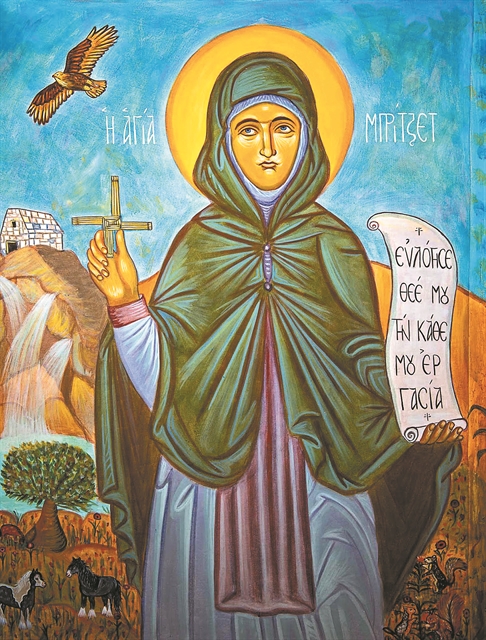
An old warehouse of a few square meters in the chapel of Osia Xeni, next to the station of ISAP Kato Patissia, filled the period of the first quarantine with saints bearing strange names and surrounded by animals and birds!

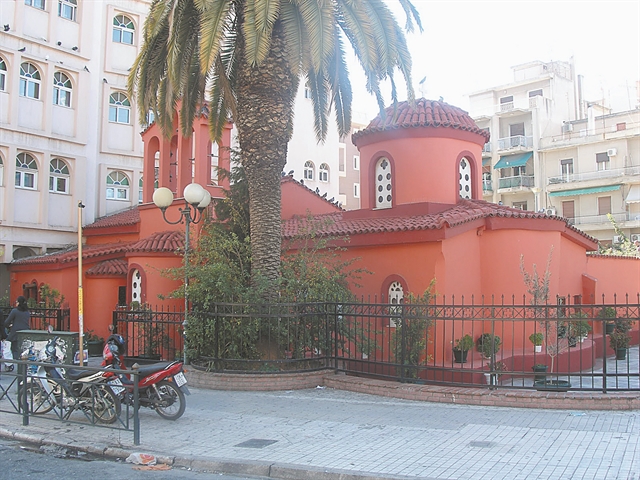
The chapel of Osia Xeni, next to the station of ISAP Kato Patissia

Afew months ago, while I was facing a serious health problem in my close family environment, a friend, in an attempt to reassure me, told me: “It’s going to be okay. I’ll stop by St. Kevin’s and light a candle.” At first I didn’t pay attention. I thought I was disobeying my agitation. But when the problem was overcome, I calmly recalled our discussion and came back asking for clarification. “Who’s St. Kevin?”

The appointment was given a few days later, on Acharnes Street, next to the kato patissia power station. Just a few metres away, among dozens of barber shops run by migrants, small and larger grocery stores with delicacies from the Arab world and countries in the former eastern bloc and restaurants with dishes from Iran to Russia, a chapel is displayed. Ceramic red, with a triple bell tower and a small courtyard full of flowers that would be more suited to the environment of an island than to the grey and concrete urban fabric.

An improvised sign at the entrance welcomes us to the chapel of Osia Xeni, which is a metochi of Agios Nikolaos Syros. And since he urges us to take all necessary means of protection for the pandemic, he invites us to meet the chapel with the Celtic saints. A chapel that counts only a few months of life as its canonization was completed during the first period of confinement, last spring.

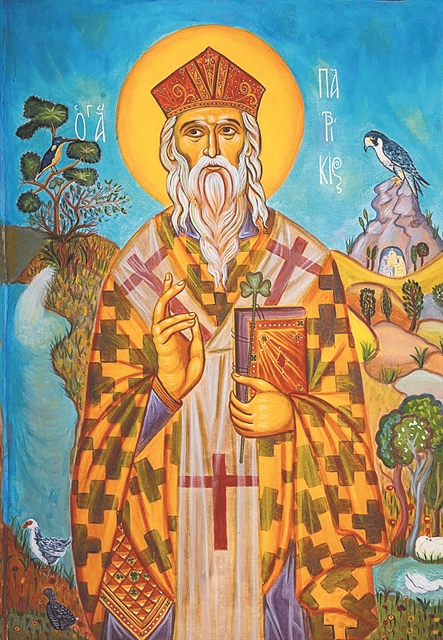
Saint-Patrikios

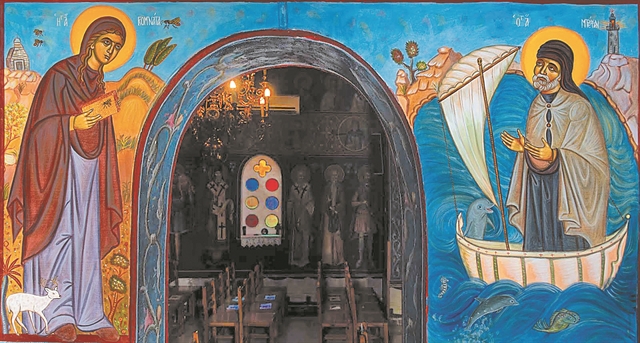
At first glance nothing seems strange in the chapel. Believers worship and light a candle. The well-known saints adorn the walls. By the time the gaze falls on an opening in the middle of the temple, on the right. “Guardians” of the entrance on either side the Saints Panteleimon and Charalambos. Among them, the inscription “Holy chapel of Celtic saints”.

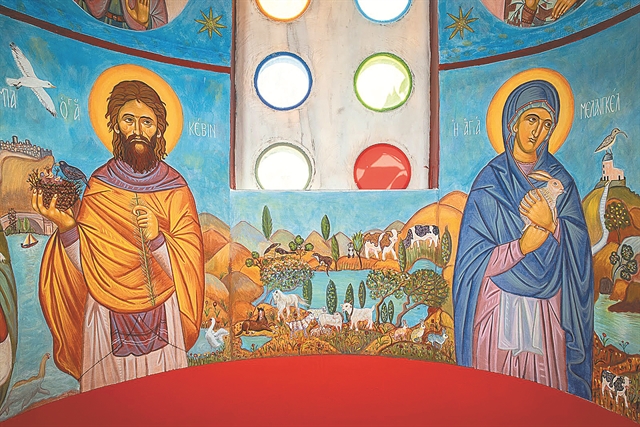
Just three square meters, chock full of 21 saints, whose names in most of us are more reminiscent of actors of cinema and in no (rather) case saints, and indeed of Orthodox doctrine.

St. Kevin’s, St. Alban’s, St. Bridgend, St. Hilda’s, St. Brendan’s… All of them small, strict in appearance, most with a sympathetic look and several of them surrounded by animals: dolphins, hares, blackbirds.

Saints-Gobnata-and-Brendan

“It is the first place in Athens dedicated to the Celtic Orthodox saints (p.p.: another chapel dedicated to these saints exists in the retreat of St. Porphyri in Melesi Attica) and could not be found a better hostess than Osia Xeni to embrace “foreign” saints” says in “NEA” the vicar, Father Georgios Ganotis, who does not only work in a church with “foreign” saints , but also in a neighborhood full of immigrants from every corner of the planet.

The chapel of the Celtic saints until about a year ago was nothing but a warehouse, in a miserable state, as he describes us, with candles that smelled and no one wanted or dared to pull the curtain covering its entrance. “Today it is a gem that combines beauty with knowledge,” he says proudly.

But who are these Celtic saints? They are saints who lived in the early centuries when Christianity arrived in Britain, Wales, Ireland. They were then lost after the roman Catholic Church and Protestantism prevailed in these areas, when many monasteries were destroyed, while the remains of the saints were even used to make mandre.

St. Kevin’s

St. Kevin, one of Ireland’s most important saints, for example, lived in the 6th century. and came from a family of the royal generation, as we read in the edition “The Celtic saints in the chapel of Osia Xeni” available only from the temple. He lived like a hermit in the Valley of the Two Lakes, near Dublin, was associated with nettles and was particularly well-groomed. In fact, an otter was once said to have brought him the manuscript of the psalms that fell on him in the lake, became friends and fished on his behalf. He is pictured holding a nest of blackbird chicks in his right hand, as he is said to have held their nest in his hand for days, motionless, until the blackbird threads its eggs and feeds the cubs so they can fly.

Saints-Kevin-Melankel

Saint Bridgeid asked Christ to make her ugly so that no one would want to marry her so that she could be insulated. Her wish came true, but in time she regained her natural beauty and reportedly performed a multitude of miracles forming only the spot of the cross. It is also due to the crosses of reeds – popular in Greece – for protection from evil. St. Brendan, although to some he is known as the fictional character of the play “Brendan’s Journey”, was born in the late 5th century BC. in Ireland and in addition to the fact that he founded many monasteries in his homeland, Wales, Scotland and France, he may have done a great sea exploration that led him to the shores of North America, hence he is depicted on a ship in the company of dolphins and other living beings of the sea. Saint Hilda who lived in the 7th century. they consulted kings, princes and bishops of England as they considered her the spiritual mother of the country.

Among them is a well-known saint to all, even today: St. Patrick, the Scottish missionary who taught Christianity in Ireland. In his youth and a prisoner of pirates, he managed to escape and then became a missionary teaching the mystery of the Holy Trinity using as an example the clover which, although composed of three parts, is a plant.

One of the questions that arises is that, since these saints are largely unknown, how did the defendant of the Holy Monastery of Panagia Vryoulon of the Holy Archdiocese of Athens, Gerontissa Philothei, manage to create the 21 hagiographies that adorn the chapel? “It wasn’t easy. I relied on information from the co-rooms and used my imagination. Hagiography is not a copy paste. Many times out of ignorance and fear we proceed to sterile copies so as not to attribute elements that do not match the Orthodox spirit. But if we observe the Byzantine hagiographers, we will find that they have been bold”, explains the abbot, who has been involved in hagiography for the last 22 years and while she had no contact with either painting or hagiography until her acquaintance with her teacher, priest Stamatis Skliris.

Saint-Bridget

From the creation of the drawings to the completion of the project, gerontissa Philothei took about a year and a half and worked with hagiography powders and glue. The difficulties were not lacking, as he tells us, when moisture problems on the roof caused the angels he had painted to fall and had to be repositioned.

The idea for the canonization of the chapel belongs to the philologist Konstantinos Ganotis (father of the vicar), who knew about the Celtic saints through his spiritual father St. Porphyrios. The latter even said that “when the Greeks discover the Celtic saints, the Anglicans will become Orthodox”.

But why did the unknowns even in the ecclesiastical circles of Celtic saints occupy a place in a temple in the heart of Athens? “We are not only interested in making these saints known in the world, but in showing the universal character of Orthodoxy. Many times we have a localistic approach, we believe that our religion concerns the Mediterranean basin and we do not realize that we are part of a larger puzzle. When you discover foreign saints, you discover that the Church is a global affair. Universal. And you understand that the saints are not our handlers and that the Church is not in our pocket,” explains Father Georgios Ganotis, who admits that the reception of these saints was initially restrained by the faithful. “But as time goes by, they worship and are interested in learning about the saints who lived so far from our land. Children come who want to see the animals as almost all these saints had a special relationship with the animals, they were nature lovers. They’re buying the book we’ve published to get more information. They approach the chapel as a part of the temple they already love,” he concludes.

WHEN FAITH MEETS FUR

Fr. Alex Chetsas

I’ll never forget the look on her face: “Father, what’s this about blessing pets this weekend? Will. ..will they be in the church?” “No, not this time,” I replied with my best deadpan. “I don’t think we have enough pews.” My parishioner and I both smiled, she a bit nervously, and on we moved toward our first “St. Modestos Blessing of the Animals Event” at my little Florida parish.
It turned out to be the start of something wonderful In our community, and I’ve kept the concept close to my heart-and in my ministry “playbook”-ever since. The idea for the event came simply enough. A few years ago a clergy friend of mine gave me an animal blessing prayer from St. Modestas, Archbishop of Jerusalem (feast day Dee. 16). He mentioned that he’d been blessing pets during Epiphany house blessings. This sounded smart: people love their pets, and this would be a low-key, personal way to connect with parishioners while visiting homes. At the same time, 1 was on the lookout for a Christmas outreach event, something a little outside the norm that would invite people to take another look at our parish. I’d been hearing for years about Catholic churches blessing animals. After doing a little research, I learned that this was also a long-standing Orthodox practice, connected to more than a few saints of our Orthodox faith.

The idea developed into a parish-wide concept, and it seemed a great opportunity to
engage in this ancient Christian tradition in a broad, modern setting. The event is held outside the church, so there is no confusion about liturgical boundaries or respect for the church building itself. I started testing the waters with parishioners whom I knew had pets; the response was overall very positive. We picked a December date that was close to St. Modestos’s feast but not too close to Christmas-near enough to ride the positive, cheerful coattails of the season, but not so close as to overwhelm our busy parishioners. Into the bulletin, Web site and local papers the announcement went. We enlisted our JOY group to sponsor the event. The children would enjoy a lunch beforehand, learn about St. Modestos and the respect he had for all that God made, and make sure all of the pets and people were well-satisfied with plenty of tasty treats.

My wife, Brandy, animal-lover and PR machine that she is, got on the phone with everyone from the governor’s office to the city animal shelter, to neighboring churches and synagogues, to every free online and traditional newspaper in fifty miles, spreading the word with a sense of hospitality, friendship and community outreach. I talked to our parishioners not only about St. Modestos but also about the real meaning of Christmas, the coming of the Lord, the Light that shines in the darkness, the Healer of all creation. And I challenged them to recall the simplicity of that unforgettable night so long ago-the brilliant-star beaming, over the cave, which nature itself offered up to our Lord for shelter. I described how the ox and the donkey (Isaiah 1:3) looked upon their new-born Master in the chilly darkness, warming Him with their breath. We talked about our unique relationship with God and what it means to be made in His image and likeness. But I also reminded them that everything God made is good-.and how all of Creation rejoices at His coming. That He comes to make everything new. This truly good news is cause for celebration, worthy of thanksgiving and a blessing.

On the big day, two major outreach aspects of the event fell nicely into place. First, our new friends from the county animal shelter joined us as promised. They brought not only irresistible puppies and kittens to adopt, but also handmade Christmas ornaments for sale. So they offered
great information and education while raising some needed funds for their outstanding, ongoing work. Second, as we Hoped, members of the general public joined us as well. This gave our parish an opportunity to be a witness of our faith in a latent, nonthreatening manner. The visitors observed glimpses of our theological and liturgical life, and we got a chance to welcome them, engage them and hopefully show them the hospitality of Abraham.

And then there were the blessings themselves. A parish council member counted, and told me later that 55 “clients” had been blessed. Among them were 41 dogs, 6 cats, 2 birds, 2 rabbits, a turtle, a goat-yes, a goat-and 2 stuffed animals (why not?). The dogs ranged from the tiniest Chihuahua to the greatest Dane I’d ever seen. I had the drool on my hands, shoes and service book to prove it. This was hands-on ministry. It made me feel like building an ark. Each encounter represented a fantastic moment of bonding with parishioners and people I’d never met before. Getting down at eye level with their pets and blessing them somehow connected us. This bond was inexplicable but real. Some pets had ailments, and I heard about these, too, from our parishioners and new friends. They knew that what was important to them was important to me-and most importantly, to our Church.

A young lady who was with us from the county shelter even pulled me aside for twenty minutes about halfway through the blessing. She told me she had a friend who was depressed and thinking about hurting herself. This young lady was worried and deeply nervous about what might happen to her friend. We talked, exchanged numbers and followed up on her concerns. God put us together on this day-somehow-and some good came of this unlikely encounter. It’s amazing what happens when we put ourselves out there.

As for my little JOY helpers, it was really inspiring and satisfying to see our children hard at work. Fresh from their fun session about St. Modestos; they were ready for action. They served the adults hot cocoa and cookies. They constantly ran to and from the parish hall refilling water bowls, gathering more doggy treats and looking for makeshift toys for anxious critters to play with. They were in charge of a unique ministry: they were caring for something; they were having fun at Church; they were taking good care of what God made. Their excitement was contagious.

At the end of the afternoon, as we were cleaning up, there was an unexpected and final blessing of the day. In the eleventh hour, an SUV roared up and screeched to a halt in front of the church. A couple I’d never met emerged, explaining that their beloved Golden Retriever was dying of cancer. He’d had several surgeries, but things weren’t looking good. They told me that they weren’t members of our community, but they had read about the event in the paper and really wanted me to bless their dog. Maybe it would help. Maybe it would put them at ease. They felt they had to do something. We tried to let them know that even though they weren’t “members” of our community, they now belonged to our parish family. After they’d left, more than a few of us were moved. We had all made new friends, and hopefully we had offered something to one another through this unique circumstance.

I share these experiences because they’ve been instructional and revealing to me. I saw my parishioners in a new light, and I was gifted with a host of opportunities to develop new relationships. I saw our children get excited about a hands-on ministry and watched some of my shyest parishioners evangelize without even knowing it. And then there was the greatest and most awesome blessing of the whole day-the holy water of the Agiasmos service enveloping us, refreshing us, renewing us and reminding us that what God made is good. This was my planned “big message of the day,” but I never really had to say the words. No sermon-to the relief of all-was necessary. For lack of a better expression, it was “acted out” by God’s people.

Since that inaugural event in Florida five years ago, I’ve seen this ministry grow and mature. At my current parish in Weston, MA, we now invite a host of animal “helping” agencies, offer microchip clinics and even feature a “doggie buffet,” compliments of a local pet supplier. OCF college students, who are part of a mentoring program within our parish, run the event. They engage our HOPE and JOY families for support. To grow the community outreach aspect, we’ve also begun to invite law enforcement: Cappy and Mighty Mouse, two equine members of the Middlesex Sheriff’s Mounted Unit, are now regular participants and major attractions. Mouse, a miniature horse, is a big draw. And this is not only a thrill for our parish children, but it also tightens the vital, indispensable bonds between our parish and the general community. We’ve even brought on a parishioner who is a professional photographer to capture that perfect Christmas shot of each pet. He accepts a small offering for each print and gives all proceeds to his local animal shelter.

What could you expect if you started a similar ministry in your parish? At the end of a pet blessing day, your priest may end up with fur on his robes. Your parish council members may shake their fist as they “patrol” the church lawn for early Christmas gifts. Some of your fellow parishioners may decide that “Fr. John has finally gone off the deep end,” and your parking lot will need a serious hose down. But that’s okay. It’s worth it. What God made is good, and it’s our duty to proclaim this truth-and act on it with creativity, conviction and great love.

FR.ALEX CHETSAS ISTHE ASSISTANT PRIESTAT ST. DEMETRIOS GREEK ORTHODOX CHLIRCH IN WESTON, MA. HE HAS SERVED PARISHESIN CALIFORNIA AND FLORIDA, AND HE NOW RESIDES IN WAYLAND. MA, WITH HIS WIFE. BRANDY, AND THEIR CHILDREN. PHOEBE AND BRAM.

Going Deeper St. Modestos of Jerusalem (Dec. 16) St. Modestos was born in 292 in Palestine. When he was less than a year old, his parents were put to death for practicing Christianity, and he was brought into the imperial household and raised as a pagan. As a teenager, though, an awakening occurred. He learned of his parents’ martyrdom, and that he had actually been baptized before their execution. A Christian goldsmith began to teach and mentor him, but the man’s jealous sons eventually sold St. Modestos into slavery in Egypt. He remained there seven years before gaining his freedom (he converted his master’s family to Christianity) after returning to Jerusalem. After a pilgrimage to Mt. Sinai, he made his way to a monastery, where he was ordained a priest. He quickly became known for his devotion to the faith, holiness and loving nature. After years of dedicated service, he was selected as Patriarch of Jerusalem. It was during these latter years of his life that his long-time devotion to God’s creation intensified and blossomed. He had a particular affection for animals-he saw animals as sublime and mysterious gifts from God. Often he would bless livestock, praying for their health and productivity and giving thanks for all Creation.

OTHER SAINTS WITH A SPECIAL CONNECTION TO NATURE & ANIMALS: St. Seraphim of Sarov (Jan. 2), shared his bread with birds and wild animals; was often visited by a bear that obeyed his words. St. Blaise/Vlassios of Sebaste (Feb. 11), blessed and healed sick animals by laying his hands on them. St. Mark the Ascetic (Mar. 5) healed a hyena cub and taught it to leave the sheep of the poor in peace. St. Mary of Egypt (April 1 and 5th Sunday of Lent) after her death, a lion guarded her body in the desert and helped St. Zosimas bury her. St. Elijah (July 20) nourished by ravens, which brought him bread and meat in the morning and
evening

“BLESSING OF THE ANIMALS” PRAYER

O Lord Jesus Christ our God, compassionate and all-good, Who fashioned in wisdom both the invisible and the visible creation; Who pour your mercies upon everything that has been made by You; Who, in Your loving providence, provide for all Your creatures, from the first to the last; hear my prayer and drive away and banish every injury and illness from all these cattle (or pets, sheep, horses or other animals), which are being used for the livelihood of your servants [name(s)]. Yes, Lord, look down from Your holy dwelling place and bless all these animals, as you blessed the flocks of Abraham, Isaac and Jacob, and of all Your faithful servants. Multiply them, grant them health, strength and productivity; render them robust and successful in the various services which they render so that their owners, having derived abundant benefits from them, may engage in all good works which are pleasing to You, and may glorify on earth Your Holy Name, of the Father and of the Son and of the Holy Spirit. Amen.

HALKI IV Keynote Address by His All-Holiness Ecumenical Patriarch Bartholomew

Opening Webinar of Halki Summit IV

January 26, 2021

* * *

Beloved friends and dear listeners,

Distinguished speakers, guests, and participants,

It is a special privilege to welcome you to this opening webinar of our Halki Summit, which marks the fourth in a series on environmental responsibility and sustainability.

These summits follow a long tradition of almost three decades. They are named after the island of Halki, just a short ferry ride from Istanbul, Turkey, the site of great importance for the Ecumenical Patriarchate, since on the top of the hill of this island, known as “the Hill of hope,” is located the historic and magnificent edifice of the Patriarchal School of Theology, which has remained silent for exactly 50 years, since the end of the academic year of 1970-1971.

But this year – and this particular summit – is unusual in many ways, not least because of the painful impact of the Covid-19 on people’s lives and interactions. This is why we wanted to dedicate a series of discussions to the relationship and connections between the pandemic and climate change.

We are particularly honored by the presence of eminent leaders, thinkers and experts, all of whom share the same vision and the same purpose, the same prayer and the same promise – namely, the healing of vulnerable human lives and a wounded planet.

Our efforts over the last three decades have focused on promoting conversation and cooperation among all faiths and all disciplines in an effort to contribute to awareness and change with regard to the ecological crisis.

The Halki Summits have proved a vital step in this dialogue and partnership. We are convinced that any real hope of reversing climate change requires a radical transformation of the way we perceive and treat the world.

However, part of the problem lies in our unwillingness to make sacrifices for the sake of others and the earth. We are called to distinguish between what we want and what we need, or – more importantly – what the world needs first and foremost.

We must be ready for costly surrender and sacrifice. As the Prophet David says in the Book of Samuel: “I will not offer to the Lord my God a sacrifice that costs me nothing.”[1] Such sacrifice is a fundamental religious and spiritual value. It is also a fundamental moral and existential principle.

At the same time, very much like the climate crisis, Covid-19 has also taught us the priceless lesson of the importance of listening to and learning from one another. Of being humble enough to care for and share with one another. Of “loving our neighbor as ourselves” so that all may have life – and “life in abundance.”

This unprecedented crisis has revealed the power and value of love and solidarity, which transcend human standards and bear the seal of God’s grace. The pandemic has reminded us that the world is larger than our individual concerns and ambitions, larger than our church and faith communities, and larger than our political powers and national interests.

During the period of this global crisis – with the mandatory restrictions and lock-downs; with the suspension of movement and travel; with the shutdown of factories and the diminishment in industry – we observed a reduction of pollution and contamination of the atmosphere. We were reminded that there can be no genuine progress that is founded on the destruction of the natural environment.

Moreover, it became apparent in recent studies that humanity’s persistent and excessive “intrusion” into nature, with the vast illegal wildlife trafficking and the destruction of the natural ecosystems, through deforestation, urbanization, intensive farming, and through the dispersion of chemical contaminants, as well as globalization and increased interconnectivity, are responsible for the quick spread of contagious diseases and viruses from animal to animal, including man. It is no coincidence that the rise in wildlife-borne diseases has occurred alongside increasing human encroachment on natural world and a rapidly changing climate. The pandemic is not an act of “revenge” by God, but it is a desperate call to a much more respectful approach to nature by all of us.

We pray above all that the God of love and mercy, creator of heaven and earth, maker of all things visible and invisible, physician of our souls and bodies, will give rest to those who have lost their lives, strengthen the sick in their suffering, console their family and relatives, and support the selfless service of healthcare and essential workers.

This time will soon pass; the pandemic will gradually subside; God will heal all wounds. Spring is already in the air. May all of us emerge having discovered a dimension of depth in all things, having experienced a “good transformation,” and having appreciated the value of the divine gifts of life and health, as well as of sacrifice and solidarity.

We sincerely hope that the Halki Summit IV deliberations and discussions will unfold fresh and fruitful ways of informing and working with one another. Whether you are participating “live” or listening to a recording, we pray that all of you will be inspired to initiate new and vital ways for a genuine conversion of hearts and minds.

May God bless you all!

1] 2 Samuel 24:24

EXCITING NEWS: Fr John Chryssavgis and Fr Jack Khalil join POCA’s new ADVISORY GROUP

We are delighted to announce a new tier to our charity’s structure – an Advisory Group.

We are honoured and humbled to have two highly respected Eastern Orthodox theologians join us in our quest to educate others on Eastern Orthodox Church teachings on compassionate care for all of God’s creatures. See further details below:

The Fr. Dr. John  C H R Y S S A V G I S is Archdeacon of the Ecumenical Patriarchate, serving as theological advisor to Ecumenical Patriarch Bartholomew.

Born in Australia (1958), he matriculated from The Scots College (1975). He received his degree in Theology from the University of Athens (1980), a diploma in Byzantine Music from the Greek Conservatory of Music (1979), and was awarded a research scholarship to St. Vladimir’s Theological Seminary (1982). He completed his doctoral studies in Patristics at the University of Oxford (1983) under the supervision of Metropolitan Kallistos Ware. While serving as Personal Assistant to the Greek Orthodox Primate in Australia (1984–95), he co-founded St Andrew’s Theological College in Sydney (1985), where he was Sub-Dean and taught Patristics and Church History (1986–95).  He was also Lecturer in the Divinity School (1986–90) and the School of Studies in Religion (1990–95) at the University of Sydney. In 1995, he moved to Boston, where he was appointed Professor of Theology at Holy Cross School of Theology and directed the Religious Studies Program at Hellenic College until 2002. In December 2020, he was elected Honorary Professor of Theology at the Sydney College of Divinity.

Fr. John also serves as senior advisor of the Department of Ecumenical Affairs of the Greek Orthodox Archdiocese of America. The author of over thirty books and numerous articles in several languages on the Church Fathers and Orthodox Spirituality, his publications include Soul Mending: The Art of Spiritual Direction (Holy Cross Press, 2000), Light Through Darkness: the Orthodox tradition (Orbis Books, 2004), The Letters of Barsanuphius and John (2 volumes, Catholic University Press, 2006–2007), and The Office of Primacy and the Authority of Councils (2 volumes, St. Vladimir’s Press, 2015–2016). He is the editor of three volumes containing the select writings of Ecumenical Patriarch Bartholomew (Fordham University Press, 2010–2012) and the official biographer of the Ecumenical Patriarch with his publication Bartholomew: Apostle and Visionary (Harper Collins, 2016). His latest book is Creation as Sacrament: Reflections on Ecology and Spirituality (Bloomsbury Books, 2019). He is also now a member of the Pan Orthodox Concern for Animals Charity Advisory Group.

Archimandrite Jack Khalil is Dean of the St John of Damascus Institute of Theology – University of Balamand and Professor of New Testament Studies. Furthermore, he has been visiting Professor at many Orthodox Theological Faculties and Institutes over the world, e.g. University of Athens, Thessaloniki, IOCS (Cambridge) and St. Serge (Paris), University of North Eastern Finland, Theological School of the Church of Cyprus, et cetera. He holds a Ph.D. degree from the Aristotle University of Thessaloniki, and studied for 3 years as Visiting Fellow at the Eberhard-Karls-Universität in Tübingen, Germany. His main fields of interest are the Epistles of St Paul and the Johannine Literature. He is the author of one book published in Greece, which has been admitted as a textbook reference at the University of Thessaloniki since 2005, and many chapters in books, researches and studies published in Lebanon, Greece, France, USA, Belgium, Germany, Estonia, and Bulgaria. He is known for his contribution on the contemporary Orthodox interpretation of the Justification by Faith in the Pauline Epistles.

Archimandrite Khalil is a member of the Biblical Federation in Lebanon, the Hellenic Society of Biblical Studies, the Revision Committee of the van-Dyck–Boustani Bible Arabic Translation, the Synodical Revision Committee of Liturgical Books, the Synodical Committee of preparing a modern translation of the New Testament.  He is also a Central Committee member in the WCC since 2013, as well as a member of its Faith & Order Commission since 2014. And he was between 2007-2012 the Eastern Orthodox representative in the WCC Continuation Committee on “Ecumenism in the 21st Century”. He was for many years the Church representative of the Patriarchate of Antioch and All The East in the Committee of the Eastern Orthodox and Oriental Orthodox Churches for the Collaboration with the United Bible Societies. He is also now a member of the Pan Orthodox Concern for Animals Charity Advisory Group.

Asceticism, Ethics, and the Renewal of the Earth: Orthodox Christian Contributions to an Ecumenical Ecology

We have been given permission by Father John Chryssavgis and Aaron Hollander to reproduce this interview on our website and we thank them both for this honour. This interview originally appeared in the November/December 2020 issue of Ecumenical Trends, a publication of the Graymoor Ecumenical & Interreligious Institute. See below for further details. An excellent way to start 2021.

The Rev. Dr. John Chryssavgis, Archdeacon of the Ecumenical Patriarchate, was born in Australia, studied theology in Athens, completed his doctorate in Oxford, and lived for a time on Mt. Athos. He has taught theology in Sydney and in Boston, and he currently serves as theological advisor to Ecumenical Patriarch Bartholomew I, known worldwide as “the green patriarch.” His latest book is Creation as Sacrament: Reflections on Ecology and Spirituality (Bloomsbury, 2019). He lives in Maine.

Dr. Aaron Hollander is Associate Director of Graymoor Ecumenical & Interreligious Institute and Associate Editor of Ecumenical Trends, currently serving as Vice President of the North American Academy of Ecumenists. He is a scholar of theology and culture, whose current research concerns the dynamics of ecumenical/interreligious conflict and coexistence, the aesthetic textures and political functions of holiness (particularly in Orthodox Christianity), and the circulation of theological understanding beyond explicitly religious settings.

Aaron Hollander, for Ecumenical Trends: Fr. John, we are so pleased to feature this conversation with you in Ecumenical Trends, as we reflect on some important ecumenical anniversaries and look with cautious optimism toward the future. We have had a lot to do with one another this year: GEII staff and our collaborators were delighted to have you join us for the “Ecology and Ecumenicity” webinar in September, and around the same time we featured a series of ecumenical responses to For the Life of the World, the new Orthodox social ethos document, in the composition of which you played an instrumental role. I was honored to participate in your interview series for the Greek Orthodox Archdiocese on antisemitism in the contemporary church, and I’m grateful that we now have the opportunity to share a little more of your tireless work and influential perspective with our readers.

Your personal and professional histories are themselves fascinating, taking you from a childhood in Australia, by way of theological, historical, and musical studies (and professorships) at the world’s great universities, to your current role as Archdeacon of the Ecumenical Patriarchate and special advisor to the Ecumenical Patriarch Bartholomew on ecological issues. Would you talk us through a few of the key milestones of this trajectory, and their significance to you today?

John Chryssavgis: Aaron, I am so glad to reconnect with you after first meeting you in Chicago many years ago, and now after these several collaborations of the past months. Your question highlights transitions that may appear curious, but there are some very fundamental connecting threads that bind together the aspects you raise. Born into a cradle Greek Orthodox and clerical family, I always envisaged combining ministry and education. That is what I dreamed of; that is what I studied; and that is what I’m doing and enjoying. That’s what took me to Athens, New York, and Oxford for academic studies; that’s what led me to Mount Athos, Australia, and America for early formation; and that’s what attracted me to the innermost court of the Ecumenical Patriarchate in recent years. It has been a journey fraught with frustration for the tensions within the institutional church, but also filled with gratification for the potential of the global church.

AH: You are very well known for your work in ecological theology and ethics, not least in light of the extraordinary global leadership of Patriarch Bartholomew on these matters. We’ll return to ecological questions a little later, expanding on your remarks at our recent “Ecology and Ecumenicity” program (which will themselves be published in a later issue of Ecumenical Trends). Yet much of your scholarship concerns the ascetic thought and practice of the early church, for instance, in works on the desert fathers and on John Climacus. How would you describe the connection between these two fields of interest, the ecological and the ascetic?

JC: Once again, at least from the perspective of my own journey and vocation, there is a direct connection between the early desert fathers (who are the center of my research and my passion) and the concern for the environment (which is at the heart of my energy and attention). I recall very vividly flying back to Australia after my studies in England and Greece, wondering how I could possibly relate or reconcile my love for ascetic and monastic spirituality in my beloved homeland Australia, a country so markedly shaped by (at best) a-religious indifference or (at worst) anti-religious secularism. It was only as I flew over the vast arid desert, which constitutes two-thirds of that continent, that I recognized the immediate association between the geography and the spirituality. I quickly became aware that the landscape had more to teach me – whether through the truth of creation or the imagination of the “dreamtime” – than I could ever hope to bring to the table in any dialogue and discussion. From this consciousness and confession emerged my first publication: an anthology of theological, historical, and literary reflections on the role and place of the Australian terrain, entitled The Desert is Alive.

AH: It’s easy to associate the desert with an ecology of deprivation and barrenness, not least when we’re familiar with the Christian ascetic tradition’s figuration of the desert as “wasteland,” “abode of demons,” and the like. But you see more than this in the cosmological orientation of the desert fathers and mothers, don’t you? What is it about the desert that speaks to Orthodox Christian understandings of ecological integrity?

JC: Most definitely. The desert is multifaceted, and the dimension of deprivation or barrenness is only one aspect, which in itself is so variegated. In Australia, for instance, the fact that people have chosen to flee the desert and live on the margins – which is exactly the opposite of what ascetic men and women did in third- and fourth-century Egypt – is surely indicative of a different set of priorities and principles. The desert is a place where you are forced to face your demons, which can easily be avoided in the distraction of a city.

By contrast, for the desert fathers and mothers, the desert was the place where you strive to meet and live with God, where you come to know yourself and open up to others, where you become attuned to your environment. There are abundant stories about the desert-dwellers and their association with nature and animals. And this is an affinity that surpasses sentimentality or superficiality. It is an alliance that transcends time and place, centuries and cultures – and so we find the same spirituality in the seventh century with Isaac the Syrian, in the thirteenth century with Francis of Assisi, and in the nineteenth century with Seraphim of Sarov. It originates in the conviction that God created and loves the world – “and all the fullness thereof” (as Psalm 24 has it) – and aspires to a reorientation and reconciliation of all things with God. If the early desert ascetics were eccentric, it is because they reminded the world that we have relocated or removed the proper center of the world.

AH: How about in the present day? As we look around at the culture and at the institutions of our industrialized society here in the US, as well as around the world, we see deeply unsustainable patterns of consumption as well as callousness toward the well-being of future generations. You’ve written about how easily human beings can become trapped in patterns of wish-fulfillment and self-prioritization: do you suppose that this applies to our institutions as well? Are we unwilling, or are we unable, to reimagine and reinstitutionalize our world for sustainability? And in either case, what can be done about it?

JC: I have been criticized for my emphasis on the ascetic dimension in responding to climate change. And I seriously contemplated and considered just how vital and practical such a response really is. But I am convinced – more so than ever before – that it is the only way of addressing the problem. There is an intimate inter-connection and inter-dependence between conscience (as self-understanding) and compassion (as concern for the world).

First of all, we know that sustainability inevitably mandates consuming and wasting less – despite how much that goes against the grain of development and progress – so we must learn to embrace the notion of “detachment” if we are truly to appreciate the notion of “attachment.” Otherwise, if we are destroying the very resources we are hoping to enjoy, that in itself should raise a red flag. Second, we have become so unfamiliar and unaccustomed to doing with less – especially in a society where we are overwhelmed and overawed by cultural images of having more and more – that we literally experience “withdrawal symptoms” and profound denial whenever confronted by the need to have or waste less. As a result, travelling light or living simply appears unnatural and uncomfortable. And finally, frankly, if it seems challenging and inconvenient, perhaps we should consider that there might actually be something to breaking the patterns or contradicting the norms. That is, after all, exactly what the early desert-dwellers proved: that there is value in stepping back to reflect; that there is virtue in surrendering in order to share; and that there is validity in assessing the impact and consequence of our actions.

AH: Many would think of asceticism as something that individuals do; or at most, we might think of community structures where many individuals live together and support one another in their spiritual exercises. But can the lessons of the Orthodox ascetic tradition be scaled up, so to speak, or (dare I say it?) modernized? Can they intervene in the political order and our civic institutions, and if so, in what ways?

JC: I have already hinted at the correlation between the personal and the political, the spiritual and the social. Both poles need to be maintained: without the personal or spiritual, there may be no direction in the political or social; and without the political or social, there may be no purpose to the personal or spiritual. For centuries, the Orthodox Church has championed – indeed, even excelled in – the mystical and liturgical dimensions of social justice and responsibility. At the same time, Western Christianity and civilization have initiated – indeed, demonstrated leadership in – the societal and legal dimensions of the Christian response and vocation. But both of these aspects must be brought and held together if Christianity is to balance the tension in its mission and mandate of being “in the world” but “not of the world.”

The problem of course is that the term “asceticism” carries with it a long history and complicated baggage; people associate it with negative, even excessive behavior. But detachment and self-denial do not have imply self-pity or self-absorption; it is not ultimately about deprivation or disconnection. Asceticism is essentially about commitment and community; it is hardly about being consumed with oneself, but rather about being concerned about others. And that means that there is a direct line from the heart of the individual to the heart of the world.

AH: ACan we take up a concrete example here? In the United States, we have been living through a time shaped by political anger and avarice, a culture of despair and carelessness, a gluttony for material pleasures at the expense of the many worldwide who are crushed under the wheels of American consumption, and what might best be described as epistemological vainglory – the conviction that the information which supports our beliefs and practices must be true because we are satisfied by it and are able by way of it to maintain what we take to be a moral or cultural high ground over others. We have just undergone a presidential and congressional election that has been regularly described as a referendum on the “soul” of the nation. In this context, do I even need to mention those remaining two of the classic eight demonic thoughts – lust and pride?

The ascetic tradition (and not only in Orthodoxy) knows how to engage with anger, avarice, despair, carelessness, gluttony, vainglory, and so forth. What does it offer, on this larger scale, to a country deeply divided and disoriented by these same realities? What might it take to “talk back” to the demons of systemic racism, ravenous profit-seeking, or tribal epistemology (none of which can be addressed adequately by individuals)? Can the ascetic tradition speak to people and institutions that have not opted into a monastic environment?

JC: I have come to appreciate that it is so simple – and at the same time so tempting – to rationalize or spiritualize the fundamental response to and vital responsibility of creation care. Clergy and theologians are especially susceptible to this kind of justification or pretext. After all, we have all the bulwarks of inquiry and insight – from doctrines to heresies – at our fingertips.

But I have abandoned the notion that I have to convince people that living simply in order that others might simply live is a way of deconstructing the demonic systems that you mention. It would be like explaining to people that prayer can light up the whole world with fire or that silence can equal a thousand words of conversion and transformation. It is not persuasive to speak these things without demonstrating them in our lives. How then can we understand the spiritual struggle “against powers and principalities” as somehow different or detached from the struggle with outward systems of oppression and consumption?

When I surrender some of my indulgence in comfort, I learn to share with those who don’t have enough to survive. When I realize the discomfort of fasting, I recall the hunger of others. And when I consider the hunger of others, I begin to crave for God. Then I begin to suspect the sacred nature of food and that I “cannot live by bread alone.” Then I begin to affirm that material creation is not under my control and is not for my exploitation. Then I begin to break down barriers with my neighbor and my world, gradually moving away from what I want to what the world needs.

AH: In one way this strikes me as following in the model of the saints, as we are all invited to do: to represent the “beautiful struggle” (2 Timothy 4:7) for a healed heart and a renewed world not primarily by arguing about how to go about it (though there is surely a place for this too!), but by living this struggle in the presence of others, in ways that others will witness and from which they will, in John Chrysostom’s conventional metaphor, “catch fire.” I think we’ve just reinvented a modern aphorism by way of ascetic theology and hagiology: “be the change you wish to see in the world.” In this context, though, I’d say it feels less like a platitude and more like a genuine basis for hope.

Let me transition here to another matter of recent ecclesiological and ecumenical importance. You had a significant hand in the special commission that produced the groundbreaking Orthodox social ethos document published earlier this year, For the Life of the World – several responses to which we featured in the previous issue of Ecumenical Trends. Would you share your own perspective on the significance of this work, and on the rationale for producing the document in the way that it was written and disseminated?

JC: This groundbreaking document has special significance given the historical background of Orthodox Christianity that we spoke of earlier. In recent years, the Eastern Church has been allergic, even aversive to social statements. This is arguably the result of a struggle to understand its place in the world resulting from long periods of isolation or persecution within many traditional Orthodox homelands, particularly those behind the Iron Curtain. But, as I already pointed out, the church has always grappled with its place and role in the world. So, whether speaking of heaven in relation to earth, or of the world in relation to the kingdom, it has covered the full spectrum from identifying (and compromising) with the world to becoming estranged (and aloof) from it, frequently being reduced to an ethnic ghetto or to nationalistic triumphalism. In the last century, the church has been frequently viewed as responsible for handling otherworldly or sacred things, whereas the state was entrusted with worldly or secular things.

Yet it wasn’t always this way. The early and Byzantine church had a bold voice on questions of social justice. Even a cursory reading of fourth-century writers like Basil the Great, Gregory the Theologian, and John Chrysostom reveals the prominence of the social core of the gospel teaching in their minds and ministry. While there may be some merit to questioning whether Christianity should merely be a “useful” accessory in a world of competing promises for security, the alternative does not need to be a Christianity that is primarily a “useless” anachronism in an age of pluralistic choices.

AH: That’s a helpful way of describing the great diversity of social perspectives (and diversity of attitudes toward social intervention) that have animated the history of Orthodox Christianity – the same, of course, is true for other churches too, even as their specific contexts may have looked rather different. So then, what is particularly unusual or significant about how For the Life of the World addresses the contemporary (that is, globalized and pluralistic) world?

JC: While the crafting of this document was in some ways unparalleled in the transparency of its process, and it was unprecedented as a partnership between the official hierarchy and the world of theological scholarship, the readiness and openness of the church to involve and inform the laity in matters related to doctrine and polity still fall far short of the ideal. An ongoing chipping away at the hardened nucleus of clericalism and institutionalism is still required. Nonetheless, the fact that Ecumenical Patriarch Bartholomew commissioned, entrusted, and endorsed this social document is in itself a welcome and refreshing shift in mentality and priority for a church that is normally associated with the past and alienated from the present.

But For the Life of the World should be received as a first step toward imperative reflection on the social ethos of the Orthodox Church as well as toward the consideration and articulation of a social role for the Orthodox Church in the contemporary world. It is intended to provide a roadmap for reconciling contemporary issues with the traditional wisdom and spiritual beauty of Orthodox Christianity, while initiating a conversation with parishes and congregations, schools and seminaries, as well as ecumenical circles and the broader community. So I am delighted that you are asking me about it and, more significantly, that you have published a series of critical responses in Ecumenical Trends.

AH: There is an important ecological message in the document, as well. Chapter VIII of For the Life of the World deals with “Science, Technology, and the Natural World.” The section draws on Maximus the Confessor’s notion of human being as a “cosmic priesthood,” and it suggests that all humans – not merely all Christians – are called to “bless, elevate, and transfigure” the earth. For our readers who are not steeped in Orthodox theology, can you unpack this claim somewhat? And to what extent does this way of thinking resonate with, push beyond, or stand in tension with Patriarch Bartholomew’s longstanding ecological vision and initiatives?

JC: In the seventh century, some of the more insightful mystics understood that they stood at a crossroads embracing the past and espousing the future with a more open worldview. Writers like Maximus the Confessor, John Climacus, and Isaac the Syrian integrated the positive traditional concepts related to the sacredness of the human body and the significance of all creation. Thus Maximus spoke of the divine incarnation as reaching “the last extremities of nature” and of the world as a “cosmic liturgy.” Maximus also described the human person as a microcosm and a mediator between Creator and creation. In such a worldview, everything acquires a sacramental seal, and everything enjoys a sacred significance.

This means that there is a dimension of art, music, and beauty in nature’s liturgy. And it further implies that, whenever we narrow life – even religious life – to ourselves and our own interests, we are inevitably neglecting our vocation to reconcile and transform all of creation. Our relationship with this world determines our relationship with heaven; we cannot conveniently or complacently separate the two. The way we treat the earth is reflected in the way that we pray to God. Walking on this planet and kneeling in church are tantamount to the same thing.

In this sense, some Orthodox theologians have spoken of human beings as “priests” of creation. And while such a definition carries with it another complex constraint of misconceptions and abuses – whether in terms of chauvinism, clericalism, or institutionalism – there is no doubt that we are called to challenge and criticize our relationship with the rest of creation, beyond that of master or proprietor, and even steward or custodian. The last designations are often championed by Christian or religious environmentalists, especially because of the long history of “stewardship” in Judeo-Christian scripture and literature. However, this too retains some of the vestiges of management, command, and even control over nature and creation.

AH: Part of what you’re suggesting, it seems to me, is that we need spiritual exercise: we need to deepen our own being through a process of ongoing conversion. Maybe we don’t give up our fundamental points of reference, but we have to recognize that we often clothe them in self-serving habits, or we mistake an ideal for a nonnegotiable course of action in the world –

JC: Yes, but even sometimes our prized moral or theological points of reference – I think sometimes we do have to give them up, or at least suspend them temporarily. Sometimes we need to acknowledge – all right, I hold my beliefs and values, but I don’t operate out of all of them all the time, and often I live them poorly. So for now, for the sake of the other’s conscience and their created dignity and the possibility of breaking free of legacies of antagonism, can I just take a step back humbly and dare to view the other’s faith and call as legitimate, offering some new insight? John Paul’s description of dialogue as “the exchange of gifts” is a good starting point. But commitment to ecumenism also involves a willingness to be changed, inviting us to the more radical “dialogue of conversion.”

AH: What does this tension between Orthodox theology and such controlling modes of human intervention in creation suggest with regard to the natural sciences, and the technological advances that they have generated? One of my favorite lines in For the Life of the World is its declaration, with no tiptoeing or ambiguity, that “the Orthodox Church has no interest in hostilities between simpleminded philosophies, much less in historically illiterate fables regarding some kind of perennial conflict between faith and scientific reason” (§71). The language of the document is crisp and clear throughout, but this struck me as a statement that is given particular emphasis. Why is this rejection of a “science-versus-religion” mentality so important? And should a distinction be drawn, then, between an embrace of science and an embrace of the technological domination of creation?

JC: For the Life of the World was actually conceived and composed well before the appearance of COVID-19. However, much of its content – particularly the section you are referring to on religion and science – is certainly pertinent and timely. For a long time, faith and science were falsely understood to be in search of different sorts of truth, as if there was more than one truth. This resulted in a dangerous dichotomy of truth as transcendent on the one hand (in the case of the church) and immanent on the other (in the case of science). In terms of creation theology, this manifested as an emphasis by science on the “book of nature” and the response (sometimes reaction, and even retaliation) of the church with an emphasis on the “book of scripture.”

However, during the current pandemic, the entire debate has emerged as a bone of contention as churches and faith communities have been compelled to address their role and responsibility toward their parishioners and constituents. It isn’t a coincidence that the pandemic is described as a crisis; and “crisis” is a Greek word that indicates judgment. We will be judged by our response to this defining moment in our lives. In the Orthodox Church – both here in the US and globally – this has culminated in a heated conversation about the way Holy Communion is distributed and received.

And what was painfully apparent during this crisis was the absence of an articulate Orthodox social ethos – capable alike of guiding the behavior of Orthodox leaders and Orthodox believers – in matters of public concern regarding the role of religion in the public space, the relationship between church and state, and the tension between faith and science. With the recent “lockdown” restrictions, and particularly with the closure of churches and temples, it has sometimes been difficult to discern whether religious leaders (in Greece and other “native” Orthodox countries) were sometimes more interested in protecting medieval treasures from imaginary enemies or in promoting conspiracy theories or global “plots” against Christianity. One exception has been the Greek Orthodox Archdiocese of America (but also some metropolitan dioceses of the Ecumenical Patriarchate in Europe), where the intense debate resulted in creative decisions. But for the most part, our churches are not always prepared (and in many cases are sinfully incompetent or at least reluctant) to respond appropriately to the most fundamental and crucial problems of their faithful in the modern world.

As for the strain between the Orthodox sense of “cosmic liturgy” and the modern drive to “master nature,” it should always stem from and lead to a creative tension that reveals a sense of humility and partnership between religious thought and the natural sciences, instead of reflecting a sense of conceit and condescension toward one another.

AH: We are living through a time that – while it may be a stretch to claim that it is somehow more ethically contentious than times gone by – can leave no doubt that the great challenges we face are exacerbated by profound ethical divisions among us. Ecological ethics, not least, can be a society-dividing issue, as well as a church-dividing issue (as was a key topic of conversation at our “Ecology and Ecumenicity” event). Have you found this to be the case in the Orthodox Church, that ecology is polarizing? What have you found most challenging and most rewarding with regard to engaging ecumenically on ecological matters – whether within your church or between churches?

JC: There is no question that adopting an ecological ethos is fraught with challenges of denial and resistance. Some of these we have already touched upon in our discussion about asceticism. But there is also no doubt that engaging individuals – whether believers or not, whether Christian or not, and even whether Orthodox or not – on environmental ethics is very often polarizing. I have watched as Ecumenical Patriarch Bartholomew has patiently and pastorally encouraged his peers in other autocephalous Orthodox Churches to recognize that creation care is part and parcel of their ministry and mission as Orthodox leaders, especially since many of them are so often preoccupied with nationalistic interests and political survival. But I have also witnessed Orthodox clergy and laity struggle to embrace the spiritual vocation required by climate change or, worse, vigorously dismiss climate change as a partisan hoax and leftist construct.

I was, in the past, inclined to contend or contest such arguments, particularly where I perceived a willingness and openness to frank conversation and sincere exchange. But when politics and ideology remain deadlocked and convoluted – when, for example, the “culture wars” in the US deliberately brand any association with protecting the environment as a boutique ideology that implies certain positions on abortion, gun control, gender and sexuality issues, and so forth – then I have to wonder if we are all reading the same Scripture. Because creation is not a partisan reality. And the libertarian ideology and mercenary selfishness of dismissing the need to subordinate our own pleasures to the well-being of creation is diametrically opposed to the Christian gospel. It is, moreover, definitely incompatible with the ascetic imperative, which we discussed earlier and which aims at restraining the crude and irrational passions of greed, envy, and lust, which are drivers behind the market economy and free trade. The jungle ethic of survival of the fittest is fundamentally irreconcilable with the liturgical ethos; the former suggests a “dog eats dog society,” while the latter resonates with the scriptural admonition to “love one’s neighbor as oneself.” For deniers, environmentalism has become a conspiracy against commerce and the freedom to consume whatever we want whenever we want. Whereas I perceive the spiritual approach as emphasizing compassion instead of consumption.

AH: I think that many of us look to the Orthodox Church as containing a wellspring of ecological insight, as it is reasonable to do with the Franciscan tradition as well. But are there aspects of your eco-theological understanding in which you have been particularly informed ecumenically, by listening to and learning from the witness of other churches? And in what ways have you learned from encounters with other religious traditions, beyond Christianity?

JC: I am so glad that you ask this question. Because it would be a sign of temptation and conceitedness to somehow imagine that, as Orthodox, we somehow hold the answer to the urgent crisis of climate change. If we did, then Athens and Moscow wouldn’t be the polluted cities they are, while the Mediterranean and the Black Seas wouldn’t be wastelands of plastic and hazards for biodiversity. As His All-Holiness “the green patriarch” Bartholomew likes to say: “We’re all in the same boat.” Nothing will happen without humility and sensitivity, without accountability and responsibility, as well as without sacrifice and compromise in order to learn the how the cry of the poor is reflected in the cry of the earth.

And in this vein, all of us must be willing to learn from and work with one another. So, yes, I have been informed by other religions and traditions, by other churches and communities, by other theologian and thinkers – from my time in Australia through my time in America. I have learned from indigenous peoples – the Aborigines and the Native Americans. Perhaps most importantly, I have collaborated with scientists and activists, establishing close friendships and networks, which have shaped many of the initiatives of the Ecumenical Patriarchate over the last two decades and longer. Orthodox clergy and theologians often forget the vital importance of “translating” basic scriptural and religious concepts into a living tradition and language that relates and responds to contemporary world. The sort of questions that are foremost in my mind – indeed, the questions addressed in For the Life of the World – are: What happens when Christians want to interpret the phrase “on earth as in heaven”? In other words, how is God manifested among us? Or what does God’s kingdom look like in human society?

AH: Again, to take a concrete example: 2020 marks the fifth anniversary of the promulgation of Pope Francis’ influential encyclical, Laudato Si’, “on care for our common home.” Can we reflect briefly on the ecumenical significance of this encyclical, which is so widely known for its ecological teachings? Have you found Laudato Si’ to be of any particular significance in your thinking about the integrity (or disintegrity) of creation as an existing unity that precedes and exceeds any division between Christians or between religions?

JC: What has become immediately apparent to me from the encyclical is not so much the specific contents or diverse interpretations of the text, but the ecumenical mandate that it represents. The integrity of the natural environment is the shared responsibility of all inhabitants of the earth. I have come to believe that, in our relationship with the earth, we are called to evoke and affirm our interconnectedness with the rest of the world, because this sense of interconnectedness reminds us that the earth unites us all – indeed, before and beyond any doctrinal, political, racial, or confessional differences. We may or may not share religious principles, ethnic backgrounds, or political convictions. But we most definitely share an experience of the earth: the air that we breathe, the water that we drink, and the ground that we tread – although this sharing is not always equitable or just. By some mysterious connection that we do not always understand, the earth reminds us of our interconnectedness.

As for the ecumenical importance of Laudato Si’, it is also important to note that, when Pope Francis began preparing the encyclical, he reached out to Patriarch Bartholomew in order to express recognition and admiration for the work achieved by the Ecumenical Patriarchate since the late 1980s. In fact, he included a prominent reference to the Patriarch and his environmental leadership in the papal encyclical, highlighting the patriarchal activities and pronouncements in an unprecedented manner. It was the first time that an Orthodox leader was spotlighted in a formal pontifical statement – this is an act of profound ecumenical significance. Prior to this, moreover, Patriarch Bartholomew had spontaneously decided to attend the inaugural mass of Pope Francis in March 2013. This, too, was an extraordinary move, the first time ever that an Orthodox patriarch was present at the installation of a Roman pontiff.

To an outsider, such events may appear insignificant and inconsequential. However, their impact on such issues as climate change is paramount and momentous. I believe that the papal encyclical letter on creation care was long anticipated not only from an ecological perspective, but also in the context of inter-Christian openness between these two contemporary religious leaders, who are personally and distinctly marked by a close friendship, while at the same time profoundly and steadfastly committed to restoring communion between their churches. There is no doubt in my mind that the favorable reception – in fact, I would venture to add also the adverse reaction to and harsh criticism – of their advocacy for God’s creation is arguably the greatest testimony and promising evidence that they are most definitely on the right track.

AH: The relationship you describe between patriarch and pope is doubtless a meaningful fruit of ecumenical friendship and love for the church universal, even in the midst of our political and ecclesial fragmentation. And that’s a fitting place to conclude, I think, as we are looking forward to the new year and to the 2021 Week of Prayer for Christian Unity, with its theme: “Abide in my love… and you shall bear much fruit.” There’s a resonantly and relevantly ecological valance of this theme, isn’t there? “Fruitfulness” requires being rooted, requires being sustained and sustainable where one is; God’s love, so to speak, functions in the metaphor as fertilizer to nourish and uphold our own ways of pouring love into the world, for its transfiguration.

Any last word you would like to offer on this sense of fruitfulness as an interpretive or prophetic category for Christian life, theology, or ecumenism?

JC: It’s true. By this [fruit] shall people know us – namely, if we have love for one another (cf. John 13:35). We know that we are on the right track, if and when we are establishing communication, building community, and affirming communion.

This is the power of ecumenical commitment and collaboration, which lies in beginning to open up beyond ourselves and our own, our communities and our churches. It is learning to speak the language of care and compassion. It is giving priority to solidarity and service. And in this respect, creation care has a vital ecumenical dimension in that it brings divided Christians and insulated believers before a common task that we must inevitably face together.

………………………………………………………………………………………………………………….

The journal offers distinctive perspectives where the church, the academy, and the interfaith field coincide, and combines reporting on current developments in ecumenical/interreligious affairs with accessible scholarship, interviews, and pastoral reflection on the dynamics of religious difference on common ground. Find out more, and subscribe to Ecumenical Trends (print and/or online), by clicking here.

Christmas Encyclical Letter

“Save the world, O Saviour. For this you have come. Set your whole universe aright”.

With the above words, Saint Romanos the Melodist introduces the last stanza of the famous Christmas kontakion. The lines are a supplication and an acknowledgement that the Lord will redeem humanity and save all creation. He Who was before all time heard the cries of humanity and came to save the world. It is this act of divine love that we remember and celebrate each year at Christmas.

The birth of Jesus the Christ was a moment in time when the course of our world was forever changed. Darkness was dispelled as the Sun of Righteousness shone, bringing hope to fallen humanity. Another hymnographer of our Church extolls us with certainty, “Christ is born, rejoice! And, we rejoice knowing that salvation has come to the world.”

This year, the joy of Christmas will be a different experience for many people, as the challenges brought about by the COVID-19 virus have changed our usual patterns of life. The preparations and festivities that normally capture our attention this time of year will be dampened by worries and concerns for ourselves and our families, for the vulnerable members of our communities, for our health care workers and our civil leaders. The essence, however, and the meaning of this holy feast remain untouched and true for us in every way. Every year, it is our hope that the bright lights and beautiful trimmings will serve to inspire an understanding and recognition that we are entering into a time of grace and light, as we prepare to receive the light of Truth. But, this year especially when we perceive the darkness around us to have grown, we feel within our hearts an even stronger desire for the light that shows us the way to the Kingdom on high. As Isaiah prophesied, “For unto us a child is born, to us a son is given.” We know that child to be the light of the world, our Wonderful Counsellor, our Prince of Peace: Christ the Lord Himself.

Although this year we may have fewer people at our table when we sit down to celebrate the birth of our Lord, we are assured that wherever two or three are gathered in His name, Christ is there present, as is the fullness of our hope in Him. Christ is our ballast amidst the storms of this life and the message of salvation is not only a remembrance of an event some two thousand years ago, but a constant offering and outpouring of love, an invitation for Him to be born continuously in the hearts of people—as the Holy Fathers of the Church themselves experienced and passed down to us. Even if our experience of Christmas this year will undoubtedly be accompanied by a prayer that next year’s feast will be restored to its full joy, we know that the love of the eternal, the living Word of God is unchanging. So, on Christmas day, and on every day, let us bow our heads in gratitude to God for the many blessings He has given us, with the conviction that we have received what was promised and more, “since God had foreseen something better for us (Heb. 11:40)”.

Together, this Christmas let us pray for Christ to come and be born in our hearts, so that His grace, peace and love may abide in us, as we abide in Him. Not only this, but let us offer, together, a doxology to Him, for He Who is gentle and lowly in heart “will bring forth justice to the nations. He will not cry or lift up His voice, or make it heard in the street” (Isaiah 42:1-2). Indeed, He comes as an innocent child to bring a new and different understanding of life to the world. He comes to bring justice, harmony, love and peace to the hearts of all, to each and every person. And, through His presence and witness, “the earth shall be full of the knowledge of the Lord forever as the waters cover the sea. (Isaiah 11:9).

May all the joy, peace, and happiness of the Nativity be with you and all the world, and may God lead us to the New Year 2021, filling it with every good and perfect gift which comes from the Father of Lights.

With paternal love and blessings,

+ Archbishop Nikitas of Thyateira and Great Britain

More than 17,000 species worldwide to lose part of habitat if agriculture continues to expand

Around 1,200 species will lose a quarter of their habitat if little is done to stop the uncontrolled expansion of the food system, research says

reports Daisy Dunne, Environment Correspondent for The Independent

More than 17,000 species across the world will lose some of their habitats if little is done to tackle uncontrolled agricultural expansion, a new study has found. The research uses modelling to estimate the extent to which continued agricultural expansion across the world could encroach on the habitat of nearly 20,000 species by 2050.

It finds that 88 per cent of these species will see some habitat loss by mid-century if little is done to curb food system expansion. Around 1,200 species could lose a quarter of their habitat.

“Business-as-usual” agriculture would also cause 33 species to lose at least 90 per cent of their habitat, according to the results. These species include 14 frogs and toads, nine rodents, and two primates, the white-throated guenon and Sclater’s guenon. Both these monkeys are native to Nigeria.

However, the research, published in the journal , also finds that habitat losses could be stemmed if large-scale changes are made to the food system. The largest savings could come from greater agricultural efficiency in developing-world regions, which could free up land from nature, according to the study authors.  

A global transition towards healthier diets, including eating less meat and dairy, could also help to stem habitat loss, said the study’s co-lead author Dr Michael Clark, a researcher of environmental sustainability from the University of Oxford. “We need to start combatting biodiversity loss at much larger scales than we currently are, and we need to start doing this now,” he told The Independent. “Until we start addressing what we eat, how it is produced, and everything in between, we’re not going to make widescale progress towards existing conservation and biodiversity targets.”

The way humans use land is currently the biggest threat to Earth’s biodiversity. However, the threat posed by the climate crisis is fast increasing, with some research suggesting that it could overtake the threat posed by land-use change by 2070. “It’s worth noting that we did not include the impacts of climate change: the huge habitat losses we projected are just from agricultural expansion,” the study’s co-lead author Dr David Williams, a conservation scientist from the University of Leeds, told The Independent. “When combined with climate change, overharvesting, hunting, pollution then things are likely to be even worse…But the conservation approaches we examined could all help reduce these threats as well.”

For the research, the authors created detailed maps showing where projected agricultural expansion could overlap with animal habitat under different scenarios. The first of these was a “business-as-usual” scenario for the world’s agriculture, which would see populations increase and the popularity of meat-based diets continue to rise in the future. The researchers find that, under this scenario, global cropland would increase by 26 per cent from 2010 to 2050. Increases in agricultural land would likely be largest in sub-Saharan Africa, south and southeast Asia and, to a lesser extent, Central and South America.

This increase would lead the 19,859 species examined to lose 7 per cent of their habitat, on average.   However, of these species, 1,280 are projected to lose more than a quarter of their remaining habitat, 350 could lose more than half and 33 could lose more than 90 per cent.

One group particularly threatened by agricultural expansion could be saddleback toads, a genus of tiny toads and frogs that are typically 1cm in length and live among leaves on the floor of Brazil’s Atlantic rainforest. Dr Williams said: “Many of them are already listed as being threatened with extinction, and out of the 21 species in our analysis, two are projected to lose more than 25 per cent of remaining habitat, four more than 20 per cent of remaining habitat, and seven more than 15 per cent of remaining habitat.”

The second scenario developed by the researchers studied habitat loss by 2050 if four different changes were made to the food system. These changes included global improvements to agricultural efficiency, a global transition to healthier diets with fewer animal products, a halving of food waste and global agricultural land-use planning to avoid competition between food production and wildlife. The authors find that, in a scenario with these four changes, global cropland would actually decrease by nearly 3.4 million square kilometres from 2010 to 2050. In addition, the average rate of habitat loss would be reduced to 1 per cent.

A global switch to more efficient agriculture would come with the largest savings because it would allow land to be freed up in biodiverse parts of the world, including sub-Saharan Africa, the researchers said.

In addition, a global switch to eating fewer animal products could help to stem habitat loss while also helping to tackle the climate crisis, the researchers said. Meat production is particularly polluting because cows and sheep are ruminants, meaning they belch out methane, a potent greenhouse gas. In addition, meat production also requires large amounts of land to be cleared for the production of animal feed and to create space for grazing. Deforestation causes CO2 to be released into the atmosphere.

“There are clear win-wins here. What we need to do to safeguard biodiversity is also going to be really good for people,” added Dr Williams.

“We should already be trying to transition to healthier diets, including fewer calories and animal-based products in richer countries, to improve human health across the world. We should already be trying to waste less food to improve food security in the global south and better support people and farmers across the world.”

New Webinar on the Animal Experiment Testing Model

Most people are unaware of the high failure rate – 90%+, of the animal testing model and of its failures to advance human health. Here is the latest very informative webinar from Dr Andre Menache, who is writing a chapter on the failure of the animal testing model, for my new book. Please feel free to circulate widely. Those of you who have my book on Eastern Orthodoxy Christianity and Animal Suffering, will know that I have written extensively on this subject.
As a Board member of the Animal Interfaith Alliance, representing the Pan Orthodox Concern for Animals charity, I recently proposed that this subject become a campaign for the AIA over the next year and this suggestion was unanimously agreed by the Board. Part of this process will be campaigning for a Parliamentary Early Day Motion asking for an independent panel to investigate the use and failures of this mode. I will keep you posted as we move forward.

Click on the link below:

GMT20201212 135857 AIA 1600×900 – YouTube

Climate Crisis and Creation Care: Eco-Economic Sustainability, Ecological Integrity and Justice


Dr Christina Nellist – (forthcoming mid 2021)

In my latest book, forty experts in a variety of disciplines and diverse cultures, interrogate various aspects of sustainable living and creation care in the era of climate change. They offer suggestions to policy makers and individuals alike, in the hope of steering us away from the cliff-edge and towards a sustainable and flourishing future, set within the confines of our planetary boundaries. That such a book is still necessary in 2021 is testament to the failure of successive governments across the world to: a) acknowledge the science and b) acknowledge the wisdom in the thousands of voices from across the world, which spoke and continue to speak, with knowledge and sincerity on this subject.

In the 70s and 80s many of us were teaching or producing scientific papers on various aspects
of what we now refer to as ‘climate change’. During this same period, some religious leaders,
like the Ecumenical Patriarch of the Orthodox Christian Church, His All Holiness Demetrios 1st,
expressed concern on the misuse and abuse of the natural environment. He called for individuals to change their hearts and minds and to view the world not as something solely
to be used as a resource, but rather, as something to nurture, by enabling creation’s flourishing. In 1989 he established the 1st September (the first day of the new ecclesiastical calendar), as the day dedicated to the protection of the natural environment, calling for Orthodox Christians to pray for the protection and preservation of God’s creation. This work on behalf of creation continues under his successor, His All Holiness, Bartholomew (also known as the Green Patriarch), culminating at this present time in the Halki Summit 111 (2019) entitled: Theological
Formation and Ecological Awareness: A Conversation on Education and the Environment, which essentially called for ‘Creation Care’ to be added to Orthodox Seminary and Academic educational programs. Similar calls and practical guidance are also found in other faiths and these are included in the book.

In the 80s and 90s progress also began to be made in the political sphere, with the 1992 Climate Convention in Rio and similar Conventions and commitments of intent, continuing until today. Yet, despite the grand words and commitments, we continue to stumble to the edge of the cliff, as if we are in some form of collective psychosis, because these very same governments refuse to implement the necessary strategies to effect real change. They appear to be more concerned with re-election, than saving the lives of their citizens and more than that, the lives, indeed existence, of the myriad other creatures on this planet. This is one of the reasons why those from a faith-based worldview are vitally important to the present debate on sustainable living in an increasingly unstable world. They provide an alternative voice and vision for the future, based in many cases upon teachings from sacred texts, which inform us that the entire world is interconnected and sacred. They provide spiritual, moral and ethical arguments on the link between climate change, a flourishing creation and goals for sustainable living.

Today, the vast majority of people understand that climate change is real and that it is dangerous. Whilst their level of knowledge on the subject varies (and it is likely that the
majority need to know more), with children to grandparents demonstrating on the streets in
countries across the world, there is at last, an acknowledgment that climate change is real
and that urgent and immediate action must be taken. Societies better understand their global
interconnectedness to each other, to other creatures and to our planetary boundaries. Our
presence, level of consumption and misuse of the natural world, has negatively changed our
atmosphere, weather patterns, environments and the lives of the creatures within those
environments. This misuse threatens all forms of life via food insecurity, rising sea levels,
mass migration and social unrest, to name just four from the awaiting crises.

Whilst recent attention has been diverted to the Covid 19 pandemic, the spectre of climate
change reality continues. One good thing arising from the pandemic is our reawakening
to the important things in life – our families, our green spaces and the creatures in them,
clean air and our health systems. Increasingly, we hear disparate voices repeating the same
message – we do not want more of the same, we want a ‘new normal’ and ‘building back
better’ policy decisions.

Dealing with Covid 19 has meant dramatic changes to the way we live, resulting
in our industries and economies grinding to a halt. Most surprising of all, is that this
‘lockdown’ has been achieved with a level of civic compliance never thought possible outside
of oppressive regimes. This indicates that the prospect of attaining the ‘new normal’ has
never been more attainable. What is required now is for politicians and policy makers to ride
the wave of desire for real change, rather than lazily returning to the destructive policies and
economic strategies of the past.

It is however, equally important for us as individuals to realise that in order to achieve
these changes, we must play our part by changing our desires and demands. Cheap
meat, cheap clothes or cheap flights are not cheap, if the full social, environmental and
economic cost of production, transportation and GHG emissions are taken into account. Cheap
is a delusion fed to us by those with other agendas; the real costs – unstable weather
patterns, habitat loss and species extinctions, ocean acidification and rising sea-levels are
now only too apparent.

Some changes are relatively easy for the individual– turning off the lights, buying green
energy; flying less often or not at all, driving more slowly, cycling or walking whenever
possible; reducing, recycling, reusing; avoiding fast fashion, giving up or reducing animal food
products and buying from local farms with better animal welfare standards whenever
possible; growing our own food; digging up lawns and planting meadows; planting more
trees; avoiding plastic; lobbying our MPs and for those who can – having less children. The
list is long enough to cater for varying degrees of commitment to change.

In this latest book, experts write with authority and clarity on various aspects of sustainable living in an era where climate change is acknowledged as the greatest threat to human existence on this planet. They write from faith-based or secular perspectives but share a desire to explain why we are in this situation and how we might affect real change, both as individuals and as societies, in order to mitigate the worst effects of climate change. They write in the hope that we – either as individuals or as decision makers in government and civil society – will be guided to respond far more quickly than is currently the case; for without swift action, we condemn future generations of human and non-human animals to lives of intolerable instability, with little hope of regaining what humans have squandered by our collective arrogance.

FOR THE LIFE OF THE WORLD TOWARD A SOCIAL ETHOS OF THE ORTHODOX CHURCH

I have chosen two sections from the Eastern Orthodox Church’s Social Document (see details below) which are found just prior to the concluding section because they contain crucial teachings regarding the non-human animal creation. My comments are in italics:

“Our reconciliation with God must necessarily express itself also in our reconciliation with nature, including our reconciliation with animals.”  Human salvation is therefore in jeopardy if we fail to care for the animal creation.

” The animals that fill the world are testament to the bounty of God’s creative love, its variety and richness; and all the beasts of the natural order are enfolded in God’s love; not even a single sparrow falls without God seeing (Matthew 10:29). Moreover, animals by their very innocence remind us of the paradise that human sin has squandered, and their capacity for blameless suffering reminds us of the cosmic cataclysm induced by humanity’s alienation from God.” The suffering of animals ought to remind us of the innocent suffering of Christ.

“We must recall also that all the promises of scripture regarding the age that is to come concern not merely the spiritual destiny of humanity, but the future of a redeemed cosmos, in which plant and animal life are plentifully present, renewed in a condition of cosmic harmony.” Animals will be in the future Kingdom of God and are not to be dismissed as non-eternal beings.

On Friday, March 27, 2020 His All-Holiness Ecumenical Patriarch Bartholomew appointed a special commission of theologians to prepare a document on the social teaching of the Orthodox Church, in the spirit of and reflecting upon the relevant decisions of the Holy and Great Council of Crete (June 2016). Commissioned in early 2017, the document assembled input from numerous eparchies of the Ecumenical Patriarchate throughout the world and was submitted to the Holy and Sacred Synod, which, in late 2019, congratulated the commission for its inspiring work and recommended the publication of this text.
For the Life of the Word: Toward a Social Ethos of the Orthodox Church is now online in twelve languages. The statement does not pronounce clear-cut responses to social challenges, but instead proposes general guidelines to difficult questions. The purpose is to initiate reflection and conversation on what “the Spirit is saying to the Churches” (Revelation 2:7). In the words of His Eminence Archbishop Elpidophoros, “This text opens us up to the implications of what it means to be loved by God, and to respond to that love by loving one another.”
While the document was completed prior to the outbreak of the COVID-19 crisis of 2020, it nonetheless addresses the importance of social responsibility, the voice of faith in a world of science, medicine and technology, as well as the response of the Church on matters related to health care, social justice, and public welfare. In this regard, the document provides a framework for addressing current challenges as well as challenges we haven’t yet imagined.
For the Life of the World presents a way of reaching out across social distancing at a time of global calamity – as our faithful are either self-isolated and quarantined (a term that literally refers to a period of forty days and reflects the church’s struggle during Great Lent) – in order to address the role of the Church at a time of spiritual crisis, challenge, and concern. Therefore, the document is being released during Great Lent as a period of self-discipline and reflection on our interdependence and vocation to care for one another. It is offered with humility and love for reflection and conversation as all of us “shelter in place.”

77 We must also recall, moreover, that human beings are part of the intricate and delicate web of creation, and that their welfare cannot be isolated from the welfare of the whole natural world. As St. Maximus the Confessor argued, in Christ all the dimensions of humanity’s alienation from its proper nature are overcome, including its alienation from the rest of the physical cosmos; and Christ came in part to restore to material creation its original nature as God’s earthly paradise.[59] Our reconciliation with God, therefore, must necessarily express itself also in our reconciliation with nature, including our reconciliation with animals. It is no coincidence that the creation narrative of Genesis describes the making of animal life and the making of humanity as occurring on the same day (Genesis 1:24–31). Nor should it be forgotten that, according to the story of the Great Flood, Noah’s covenant with God encompasses the animals in the ark and all their descendants, in perpetuity (Genesis 9:9–11). The unique grandeur of humanity in this world, the image of God within each person, is also a unique responsibility and ministry, a priesthood in service to the whole of creation in its anxious longing for God’s glory. Humanity shares the earth with all other living things, but singularly among living creatures possesses the ability and authority to care for it (or, sadly, to destroy it). The animals that fill the world are testament to the bounty of God’s creative love, its variety and richness; and all the beasts of the natural order are enfolded in God’s love; not even a single sparrow falls without God seeing (Matthew 10:29). Moreover, animals by their very innocence remind us of the paradise that human sin has squandered, and their capacity for blameless suffering reminds us of the cosmic cataclysm induced by humanity’s alienation from God. We must recall also that all the promises of scripture regarding the age that is to come concern not merely the spiritual destiny of humanity, but the future of a redeemed cosmos, in which plant and animal life are plentifully present, renewed in a condition of cosmic harmony.

§78 Thus, in the lives of the saints, there are numerous stories about wild beasts, of the kind that would normally be horrifying or hostile to human beings, drawn to the kindness of holy men and women. In the seventh century, Abba Isaac of Nineveh defined a merciful heart as “a heart burning for the sake of the entire creation, for people, for birds, for animals . . . and for every created thing.”[60] This is a consistent theme in the witness of the saints. St. Gerasimos healed a wounded lion near the Jordan River; St. Hubertus, having received a vision of Christ while hunting deer, proclaimed an ethic of conservation for hunters; St. Columbanus befriended wolves, bears, birds, and rabbits; St. Sergius tamed a wild bear; St. Seraphim of Sarov fed the wild animals; St. Mary of Egypt may well have befriended the lion that guarded her remains; St. Innocent healed a wounded eagle; St. Melangell was known for her protection of wild rabbits and the taming of their predators; in the modern period, St. Paisios lived in harmony with snakes. And not only animals, but plants as well, must be objects of our love. St. Kosmas the Aetolian preached that “people will remain poor, because they have no love for trees”[61] and St. Amphilochios of Patmos asked, “Do you know that God gave us one more commandment that is not recorded in scripture? It is the commandment to love the trees.” The ascetic ethos and the Eucharistic spirit of the Orthodox Church perfectly coincide in this great sacramental vision of creation, which discerns the traces of God’s presence “everywhere present and filling all things” (Prayer to the Holy Spirit) even in a world still as yet languishing in bondage to sin and death. It is a vision, moreover, that perceives human beings as bound to all of creation, as well as one that encourages them to rejoice in the goodness and beauty of the whole world. This ethos and this spirit together remind us that gratitude and wonder, hope and joy, are our only appropriate—indeed, our truly creative and fruitful—attitude in the face of the ecological crisis now confronting the planet, because they alone can give us the willingness and the resolve to serve the good of creation as unremittingly as we must, out of love for it and its creator.